By Vinny Porco
Candidates for the Student Government Association’s “Top 4” positions discussed their campaigns in Floyd Theater on Wednesday night. Students, mostly SGA personnel, gathered to hear key issues on this year’s ballot.
U of L senior and SGA Supreme Court Chief Justice Morrigan McIntosh moderated the forum. She first asked questions to seven candidates running for academic vice president and services vice president before shifting to six candidates running for Executive Vice President and Student Body President. Candidates then answered questions from the audience.
Here are the takeaways.
How do candidates plan to balance and improve student services and lower student fees?
Academic vice president candidates Kamani Killings, Harrison Grill, Roger Phelps and Gabriel Reed pitched their ideas to an awaiting audience.
Reed valued realism in his ideas; he pitched a “syllabus bank” to promote academic transparency during class registration at little to no cost.
Phelps proposed auditing student resources and services. He suggested protecting and expanding those most used by students, while cutting those that are underused.
“There’s a concept that you can keep adding service, but not add costs,” Phelps said. “Well, that clearly just don’t work. It’s not a common-sense idea.”
He argued that lowering costs could help persuade the administration to reinvest the savings in students.
Grill seconded the idea of auditing resources and discussed an “academic resource hub” to streamline this process and promote student accessibility.
Killings, on the other hand, strongly opposed cutting any resources or services. She trusts that students will continue using campus resources. Instead, she urged these resources should be expanded in creative ways.
“The cost of learning is a lot, and it falls as a huge burden on students,” she said. “I would like to continue what I’ve already done, which is a textbook drive to have students donate their textbooks for service hours.”
How will candidates professionally prioritize students’ interests while maintaining decorum with administrators?
Services vice president candidates Cameron Austin, Connor Price and Lily Gordon highlighted their strategies for balancing student advocacy and relationships with services personnel.
Austin committed to not being a “yes-man” when the well-being of students is at stake. He plans to do so while remaining respectful of other services personnel involved.
Price said transparency is paramount to maintaining student interest. He told the audience, “One of the campaign platforms I’m running on is transparency, a promise to the students to share to the extent that is legally allowed.”
Finally, Gordon said she would find common ground with services personnel. Gordon explained that she would frequently solicit student feedback to bring it to the decision-making table.
How will candidates ensure that the Athletics Department, Board of Trustees, Office of the President and Office of the Provost don’t step over SGA when convenient?
Candidates answered a question from The Cardinal during the audience Q&A.
EVP candidates Riley Maddox, Seth Pinson and Trey Stephens outlined how they would keep SGA in the mix of students’ most high-stakes issues.
Maddox centered her response around being vocal and passionate about students’ well-being. She foregrounded students’ direct involvement.
“Bringing students along with you to share their testimonies and how it’s really impacting them is so important,” said Maddox.
Pinson addressed specific issues; he lamented the removal of Wendy’s on the Belknap Campus and discussing his experience working at Yugo Louisville Nine, a U of L affiliated apartment.
He told the audience that some changes are “outside issues” removed from direct involvement, and that he appreciated his ability to address these issues as chief of internal affairs. He also that argued building balance and a good rapport with administration are crucial to being taken seriously.
Finally, Stephens focused on fees like the recent $200 Athletic Fee imposed before the beginning of the fall 2025 semester. He stated that his administration would be informed by past experience fighting student fees, ensuring proposals be kept low and relevant to students.
He continued by acknowledging not all issues would be in their control, emphasizing student involvement in those cases. He explained, “In some situations, the best we can possibly do may be just alerting students as soon as they can possibly know and making sure they get that information correctly.”

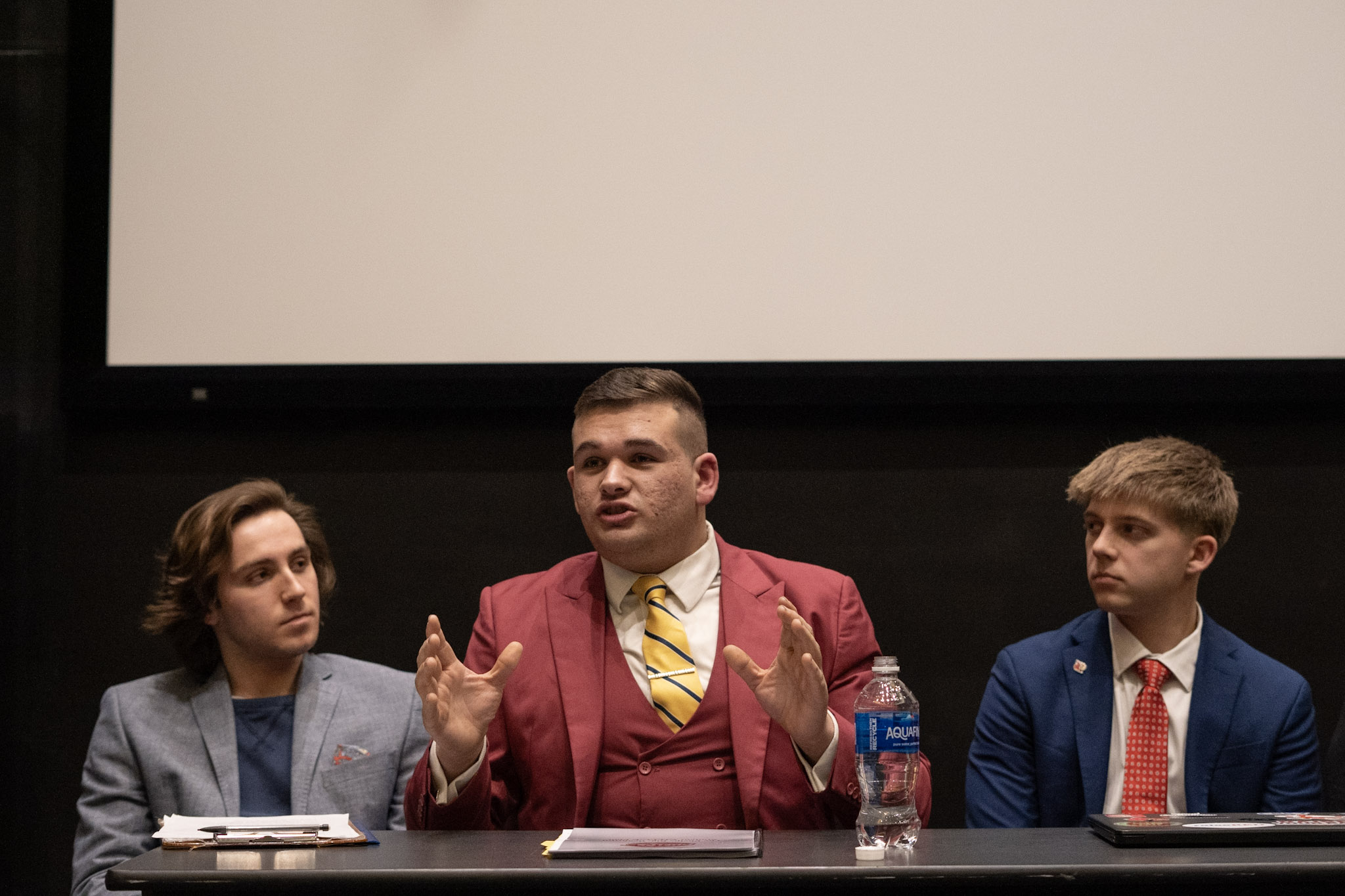
Kathleen Price, right, discusses her plans if elected student body president during the SGA Campus Issues Forum on Feb. 11, 2026. (Photo by Jai’Michael Anderson / The louisville Cardinal)
How will candidates realistically manage student interests if a call for change involves a Board of Trustees vote?
Student body president candidates Mariana Meneses, Kathleen Price and Yash Arabati showcased their approaches to student advocacy rooted in their deep campus involvement.
Meneses opened by explaining her role within the College of Business, one which included gathering student feedback and weighing consequences of issues such as student fees.
“I’m a student first,” she said, pledging to vote with students’ best interests even if they conflict with her own.
Price followed, describing the benefits of her position as current academic vice president, where she serves as a non-voting ex officio member of the U of L Faculty Senate. She emphasized bringing documents, statements and policies back to the Student Senate for review, a system of feedback she said her and current Student Body President Macy Waddle have in common.
Finally, Arabati tackled McIntosh’s question through the specific lens of divestment from Israel. He assured attendees he researched the issue, and promised to fully represent students to this end no matter where the finances in question may be entangled.
“I am a pawn of the students,” he said. “I am one of them.”
Election timeline
Voting for the 2026 SGA General Election opens through university email Monday, Feb. 23 at midnight and closes Thursday, Feb. 26 at midnight. Official results will be released Friday, March 20.
Photo by Vinny Porco / The Louisville Cardinal