By Sydney Ball
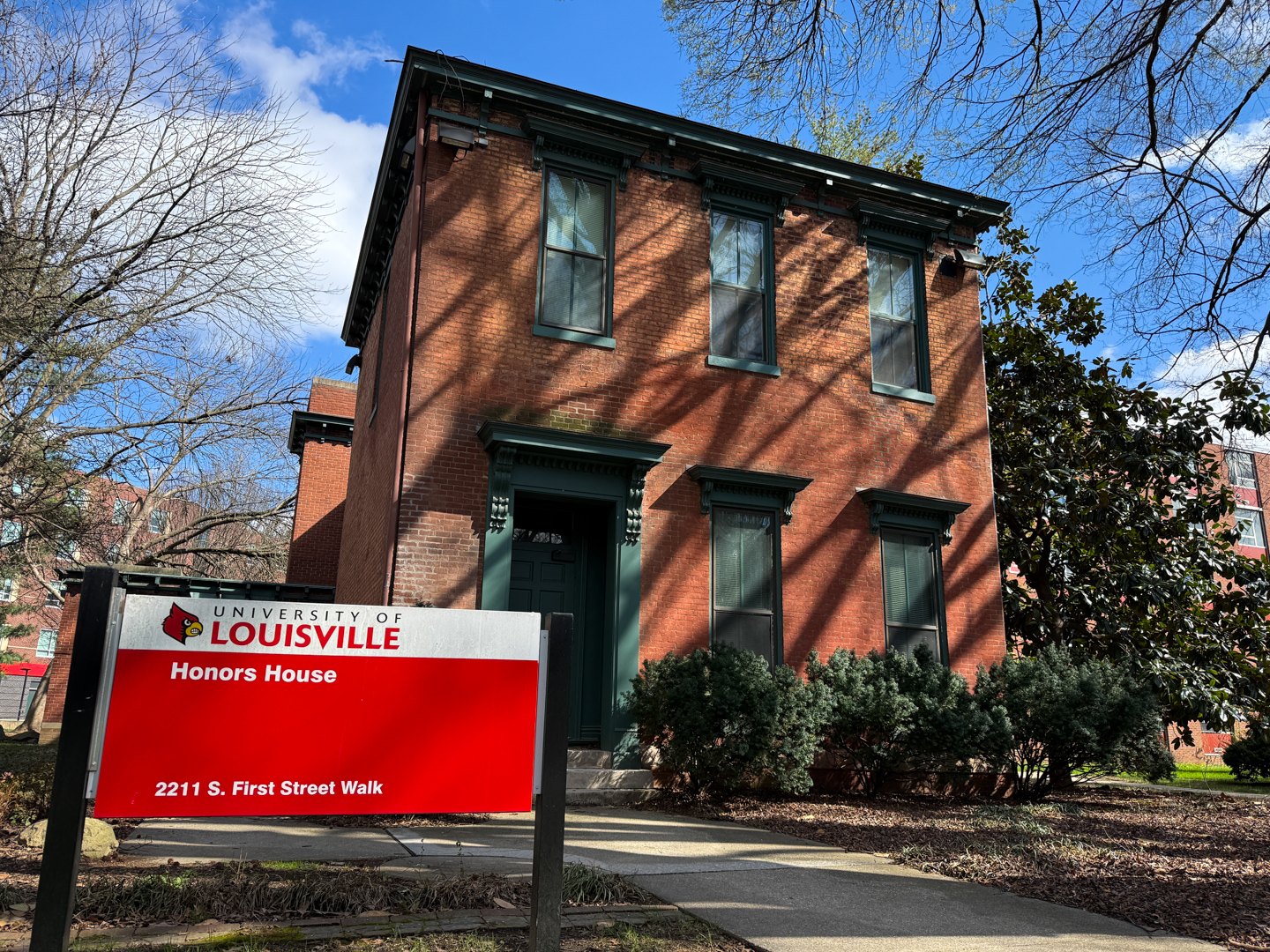
Over the years, buildings at the University of Louisville have come and gone, but the Honors House has stood the test of time.
However, some students are concerned that it won’t stand for much longer.
Originally a residential building, the Arts Center Association of Louisville acquired the house to host classes for students, veterans and youths in the Louisville community.
The Honors Program moved into the house in the early 1990s following a preservation project.
Luke Buckman, an advisor for the Honors Student Council, said that the house was a “thriving hub of activity.”
An uncertain future
Three years ago, the Office of Facilities Management notified the Honors Program that the house’s main building was no longer safe to occupy. This building was constructed over an unstable basement.
Although Buckman loves the house, he said that this was the right call.
Currently, the Honors Program occupies two spaces on campus: the Etscorn Honors Center in Strickler Hall and the Honors Living Learning Community in Kurz Hall.
Buckman is happy with this arrangement. Strickler offers more space than previously available.
With that said, members of the Honors Student Council Historian Committee are not quick to leave the Honors House behind.
Still, committee members are taking action to preserve the building. They believe that the Honors House is too historically relevant to be left vacant indefinitely.
The committee is applying to have a historical marker placed outside the house. If successful, the state will pay for the building’s preservation.
Restoration is a journey
Meals hopes that the house will be restored and reopened.
Kristin Dodge, vice president of the Historian Committee, believes the house’s location is a prime spot to host campus events.
“Accessibility to such an easy spot on campus would be beneficial to the greater student population,” said Dodge.
The Free Store recently took advantage of this by relocating to the back annex of the Honors House during the summer of 2025. The annex is not located over the basement and is therefore safe to use.
Since moving, the Free Store has seen an increase in both its number of visitors and donations, according to manager Lily Clagett.
Clagett suggested that the Honors House be used as a student resource hub, housing the Free Store, bike repair shop, Hire Attire and the Cardinal Cupboard.
Buckman echoed this sentiment. If U of L were to invest into restoration, he believes that the house should serve the entire student population.
As part of their campaign, the historian committee is producing a documentary about the Honors House. The Floyd Theater will show the film at 5:30 p.m. on April 7.
The documentary will explore the residential, artistic and educational phases of the Honors House. It will also detail the house’s closing and the historian committee’s goals for the future. The committee is aware that they have a challenge ahead of them.
“Even if we don’t get the marker, as it is a quite a rigorous and competitive application process, it’s just a good experience for us,” said Meals.
In particular, he believes that the committee has become better equipped to share the building’s stories.
They certainly haven’t lost hope.