By Claire Schneider
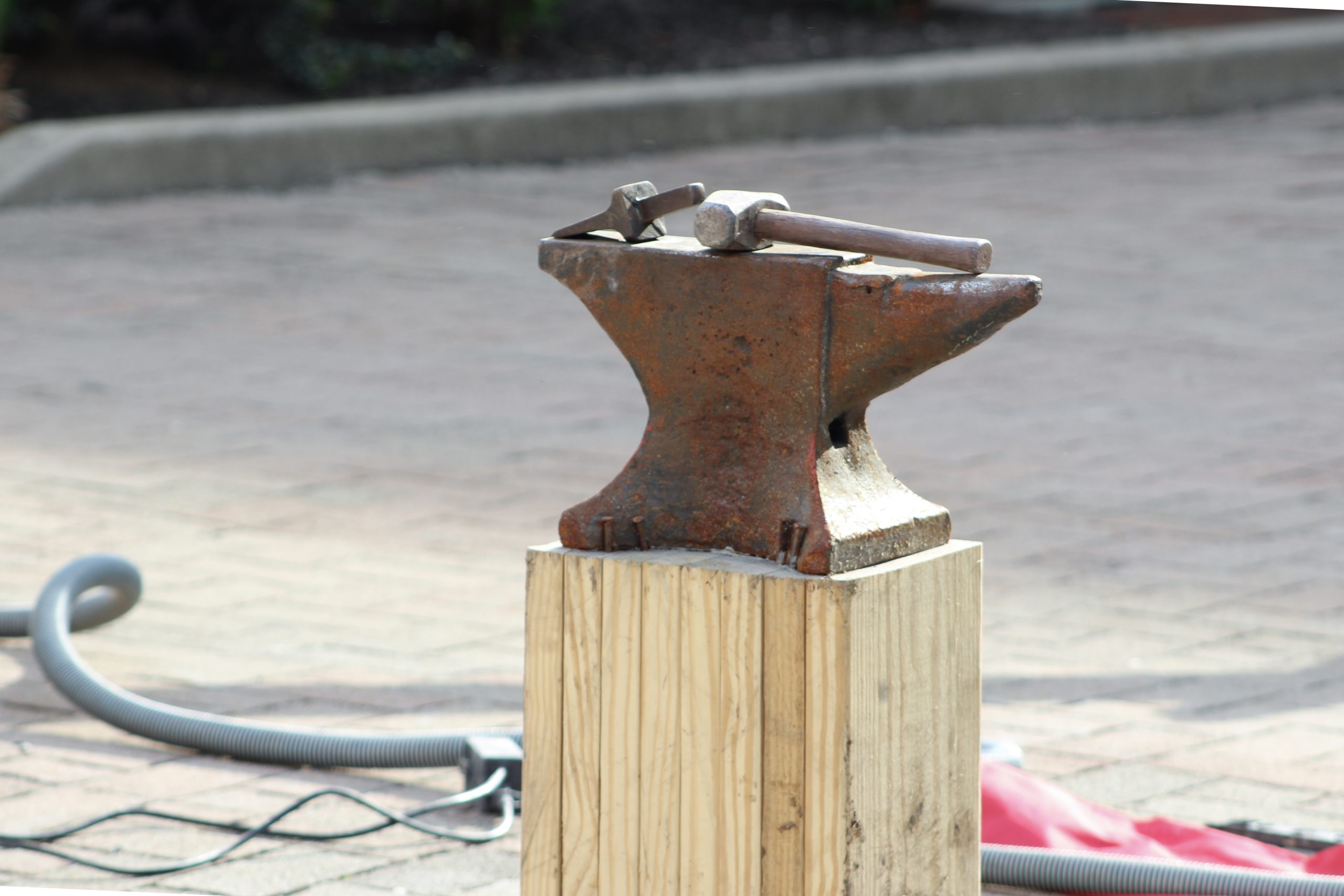
Last week, University of Louisville students forged a path to the past in a bloomery smelting workshop. Participants executed ancient blacksmithing techniques guided by Dr. Andrew Welton, a blacksmith specialist based in Mars, Pa.
Smelting on campus
Held from April 13-15, many arrived at 9 AM as the workshop began for the day. A section of the Red Barn plaza was blocked off by barricades, where the workshop took place. Participants were required to sign waivers, and wear closed-toe shoes and natural fibers.
“We followed all the safety precautions and we got all the permissions from the fire marshal,” said term professor in the history department Rebecca Devlin.
A wide variety of students have observed or participated in the workshop, including those involved in history, anthropology, chemistry, engineering and film studies.
On Monday, participants created balls of clay. On the second day, those balls were used to build a furnace. Finally, the smelting process began as charcoal and iron ore were added to the furnace on Wednesday.
“We’re actually smelting the ore itself down into metal,” student volunteer Caden Hamilton said.

Caden Hamilton pours iron ore into a furnace. The furnace was designed to resemble Louie, U of L’s mascot, April 15, 2026. (Photo by Claire Schneider / The Louisville Cardinal)
Making the workshop happen
Devlin was inspired to bring the workshop to campus after Hamilton mentioned he was a blacksmith hobbyist himself. She knew of Andrew Welton from her PhD program at the University of Florida, who’d studied medieval weapons. He wanted to bring these artifacts into the present and began teaching blacksmith bloomery smelting across the United States.
“When I realized that Caden was going to graduate this year, I knew I had to organize it this year,” Devlin said.
After contacting Welton, Devlin and the students had to fundraise. The efforts were spearheaded by Eta Sigma Phi, the classical honor society, and Phi Alpha Theta, the historical honor society. This involved contacting other adjacent groups for volunteers, financial support and a percentage night at El Tarasco Mexican Restaurant.
“It is a rather expensive event to put on, because there are so many materials involved,” Alexandria Groves said, vice president of Phi Alpha Theta and sergeant in arms of Eta Sigma Phi.
Experimental archeology for students
Experimental archeology refers to replicating historical processes to better understand the past. These are often the processes used by the ancient working class, where archeological evidence rarely gives the full picture.
“We don’t have a lot of written sources by or about blacksmiths, so very few things will tell us what their experience was and why they were doing things in certain ways, or how they learned those things,” Devlin said.
Additionally, experimental archeology makes the past more real. According to Groves, many assume that history is simply discussing dead people.
“Having these hands-on experiences can help students feel a connection to history, to get them more involved and more motivated to learn about it, because everything that happened in history influenced where we are today,” Groves said.
This specific method of blacksmithing was used for thousands of years, giving it an important place in human history.
“It’s useful to see where we came from,” Hamilton said.
Photo by Claire Schneider / The Louisville Cardinal