 By Deanna Tran
In mid-2006, the U.S. Census Bureau released a report on the 2004 general election revealing surprising results. Numbers showed that in the presidential election between President George W. Bush (R.) and Massachusetts Senator John Kerry (D.), voters under 30 represented more than 20.1 million of the total votes, 4.3 million more than in 2000.
These numbers challenged the initial news reports of 2004 that had quickly concluded no change in the dismal behavior of young voters, simply because their turnout numbers were lowest.
Census reported that voter turnout for the 18 to 24 age group increased 11 percent from 2000, which was the largest increase in voter participation of any age group in the 2004 election.
The Vanishing Voter Project, funded by the Joan Shorenstein Center on the Press, Politics, and Public Policy at Harvard University’s Kennedy School of Government, studied the surprising 2004 voting trends of young people.
The project conducted seven national surveys and concluded that the top three factors that steered young voters to the polls that year were a concern for pressing issues such as Iraq and the economy, a dislike for one of the candidates and personal contact or encouragement by either friends or family.
The project also reported that fewer than 10 percent of young adult voters cited that campaign or group contact influenced their turnout decision.
President of the College Democrats at the University of Louisville Melanie Tate, a political science major, said, “[Those turnout] numbers are somewhat misleading, Young people voted in higher numbers than ever before in 2004, but since turnout overall was so much higher among every demographic group, that accomplishment was overshadowed.”
Overall voter turnout was higher; the Census reported 126 million people voted in the Nov. 2004, a record high for any presidential year.
Yet amid these promising statistics the fact remains that the 18 to 24 age group still has both the lowest voting and registration rates.
Chair of the College Republicans and the University of Louisville, Michael Wray, a senior studying biology and political science, said he is “greatly discouraged by the fact that college-aged students do not take more of a vested interest in their futures,” said Wray.
College-aged students are at a university or college preparing for their careers by obtaining an education, and yet they ignore their responsibilities to prepare for their future by expressing their constitutional right to vote.” said Wray.
Both leaders of the two student political organizations stress that the main reason that young people go out to vote is that it will bring attention to the pressing issues that they face today.
“It is vital for young people to vote in every election they can, to make their presence known, so that candidates start paying more attention to issues that matter to young people, such as student loans, the rising cost of a college education, and access to affordable health care,” Tate said.
“Election issues are more than talking points on entertainment news networks; they are problems and issues facing our society, and election time is the chance the people get to speak up.” said Wray.
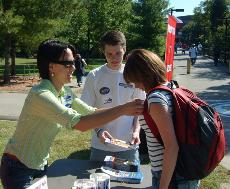
Both the College Democrats and College Republicans at U of L are focusing major efforts towards increasing voting and registration by college students.
For this election season, Wray said the College Republicans have actively worked with many local and national campaigns, “whether walking door-to-door or simple administrative duties, we are involved.”
And to facilitate voting needs of students not from the 3rd district of Kentucky, Wray said that they’ve provided absentee ballots and helped in changing student’s voting registration to Jefferson County.
“We encourage involvement and a pro-active attitude, from our members,” Wray said.
Tate reported that the College Democrats have held voter registration drives on campus, handed out stickers and campaign literature, and had representatives from the clerk’s office come to talk to the organization.
“Whether a student is a Democrat, Republican, or Independent, I want to encourage everyone to register, because regardless of party, at our age, getting out to vote is important for our future,” Tate said.
Contrary to those beliefs, political science and philosophy major Anthony Cash, a junior and McConnell Scholar at U of L, said that the focus should not be on simply driving large crowds out to the polls, but instead it should be on educating people so they can make knowledgeable decisions when they do go out and vote.
“This notion that everyone is to vote all the time, regardless of whether or not they feel that they need to vote or have to, is a touchy feely sentiment. It makes us all feel better, but in a world of reason, it doesn’t make any sense. It is not a reasonable position,” Cash said.
Responsibility, Cash said, is directly tied with a person’s right to vote; “Every citizen has a right to vote, but they also have a responsibility to be reasonably acquainted with the issues and the candidates for which they are voting, therefore it is more responsible for a person who is not acquainted to not vote than to vote without that information.”
To Cash, it is not about how many people vote but how they vote. “Any group of voters, if they are willing to turn out in high numbers, can have an effect. Whether or not that is a good thing is dependent on how educated they are about the issues that are pressing, the candidates and their positions on those issues.”
However diverse views may be about young voters, it is clear there is growing involvement and increasing passion by young adults to stay aware and to be involved in government issues.