 By Baylee Pulliam
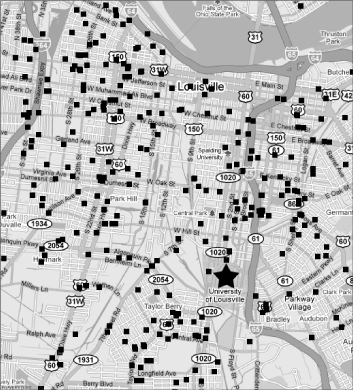
One click of the mouse and the map on the screen is cluttered with little red dots. They cover the labels for Fourth Street, Floyd Street and many others within five miles of the University of Louisville Belknap Campus. Each one represents a registered sex offender on the Kentucky State Police map. And there are 364 of them.
“There is a fairly significant cluster,” said Dr. Richard Tewksbury, a professor in the justice administration department. “This neighborhood seems to draw a lot of them because it’s pretty affordable, apartment rentalwise.”
With so many sex offenders near campus, some students are concerned.
“According to the e-mails that the university sends us, the area where I live has one of the highest crime rates,” said Erica Jones, a junior sociology major who lives near Gray’s Bookstore. “I don’t really feel safe walking around at night.”
Tewksbury contends that students shouldn’t be concerned.
“There’s very little danger,” said Tewksbury. “The vast majority are not predatory. They aren’t lurking in the shadows waiting to jump out at you like most people think.”
Lt. Colonel Kenny Brown, assistant chief of the U of L Department of Public Safety, agreed with Tewksbury.
“Like any crime, there should be some concern about sexual assault,” said Brown. “But you’re really more likely to be mugged than attacked by a sex offender.”
In fact, according to Brown, there were only two instances of sexual assault on the Belknap Campus last year, both associated with known offenders.
“What you have to remember is that not all sex offenders are continuously looking to victimize,” said Tewksbury. “Most are just regular people who have made one or a few serious mistakes in life. You don’t necessarily become a sex offender by raping someone.”
However, DPS does suggest some ways for students to protect themselves.
“If you’re out walking at night, travel in groups,” said Brown.
Kimberly Robinson, a sophomore English major, said this is something that is very important for her.
“I always make sure I have someone walking with me at night,” said Robinson. “I feel safer that way.”
Brown stressed that students should use common sense on campus.
“If you see something that looks suspicious, report it,” said Brown. “We would much rather respond to a call that turns out to be nothing than file a report on an assault.”
DPS also takes several steps to ensure student safety, such as providing an escort service, patrol officers, safety classes and emergency call buttons.
“We take this seriously,” said Brown. “We pay attention to the crime statistics in the area and send out a message over RAVE text message alert and e-mail each time there’s an incident. This is overall a very safe campus.”
On Jan. 27, for instance, the University Police responded to a report of “possession of matter portraying sexual performance by a minor” in Davidson Hall, according to the January crime log on the University Police Web site.
“We respond to and stop crimes before they become serious, if we can,” said Brown. “Not too long ago, we had a report of someone on campus that shouldn’t have been. We caught him in a stairwell before anything happened.”
The advice of Brown and Tewksbury is to be aware.
“Know your surroundings and report anything that seems unusual,” said Tewksbury.
With so many safety measures in place, the likelihood of being sexually assaulted on campus is relatively low.
“There aren’t any especially high levels of risk, as long as we take precautions against basic crimes,” said Tewksbury. “I’m really more afraid of some student stealing my stuff.”