 By Billy S. Garland
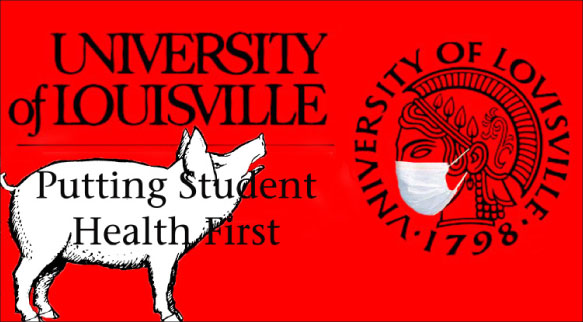
Last Tuesday, Dr. Phillip Bressoud, the executive director of Campus Health Services, announced in the Student Government Association Senate meeting that the University of Louisville has had one confirmed case of the H1N1 virus. On Sept. 11, the university announced this information on their Web site. This announcement came after many worried months of wondering if and when the university would be hit with a case of the widespread epidemic. There have been no other cases reported, but that may not be enough reason to relax.
“So far we only have the one confirmed case,” said Cynthia Hess, U of L director of communication and marketing. “I say ‘confirmed’ for a few reasons. We can’t be sure there aren’t other cases, because some students simply aren’t having themselves tested. And others are being tested with the Rapid Flu Test, which does not distinguish between types of flu.”
The university has been working for some time now to get prepared for this flu season. Beginning in January, Campus Health Services started gathering the seasonal flu vaccine and working to prepare students, informing them how to avoid contracting and spreading the flu.
“Flu germs are transmitted by direct contact,” said Karen Newton, U of L director of health promotion. “We encourage students to do all of the basics. Wash your hands regularly. Don’t share drinks…If students can be really smart about direct contact, they can cut down their risk of getting sick.”
In an effort to encourage these behaviors, campus health workers have handed out over 3,000 personal-sized bottles of hand sanitizer. They have also been distributing cold and flu kits, with all of the supplies necessary to fight cold and flu symptoms. Adding to the personal care items that have been distributed, the center has also been giving out seasonal flu shots to students.
“At present, our charge is the seasonal flu,” said Newton. “We are encouraging students to get the seasonal vaccine, if they will. This, combined with smart health practices, can go a long way to keeping a student healthy. The smarter a student can be about these things, the better. It really becomes a life skill.”
Due to flood damage to their main office, Campus Health Services has been forced to administer the vaccines to students elsewhere. Last week, the shots were given in the Miller Information Technology Center. This week, they will be given out in the Student Activities Center.
“We would prefer to administer the vaccines in our office,” said Bressoud. “We feel it is necessary to immunize as many students as possible. A lot of people worry that getting one will affect their ability to get the other vaccine—it won’t.”
While the current focus of the university is on the seasonal flu, their attention is shifting toward the arrival of the H1N1 vaccine. As of yet, no exact date has been set for when the vaccine will become available to students.
“The first supply is supposed to ship around mid-October,” said Bressoud. “Unfortunately, there hasn’t been an exact date set for when it will ship, so we can’t give one for when the vaccine will be here.”
According to Bressoud, the first supply of vaccines will be small. The shipment will only contain around 1,000 shots. As a result, there will be a system of prioritization for who can get one of the first H1N1 shots.
“We will be following regulations set out by the Center for Disease Control about who are priority candidates,” said Bressoud. “Pregnant women and healthcare workers are a high priority. Also, anyone under age 24 is considered high risk for H1N1, especially if they have any underlying medical conditions.”
Notifications will be released as the H1N1 vaccines become available in the area. Dr. Bressoud wants to make sure that all students have the opportunity to get a vaccine.
“A lot of students don’t think they are candidates for the vaccine,” said Bressoud. “Actually, college students are part of the target population. Everyone on campus is encouraged to get an immunization. We don’t
want anyone getting really ill. It can happen. And when it does, it’s usually pretty severe.”
In sharp contrast to Bressoud’s concern, many students are less than worried about contracting the H1N1 strain.
“It makes you take extra precautions,” said junior chemistry major Emily Doss. “But I think it is being blown way out of proportion.”
Holding a similar belief that the worries about H1N1 are misplaced, some students, like senior chemistry major Jenny Gilbert, have chosen to take their chances with the swine flu. Gilbert says that she is not worried because she is a healthy individual. She is choosing to opt out of getting the H1N1 immunization because of mistrust of new vaccines.
“I don’t trust new vaccines,” said Gilbert. “Think about how many times new drugs have had to be recalled.”
Junior English major Neil James echoed this sentiment, but acknowledged his own tendency to worry about contracting H1N1.
“Right now I have a cough,” said James. “Whenever I hear someone cough or sneeze, I immediately think of the swine flu. The fact that I worry about it so much shows how we, as a community, are overly paranoid. It is good to have a certain level of concern over things like this, but when concern turns into paranoia, we have a problem.”