 By Elijah Mckenzie
At a college as diverse as the University of Louisville, students are fortunate to have an eclectic mix of backgrounds, experiences, talents and traditions in their professors. Additionally, many professors hold other jobs as well, allowing students to see their teachers in a whole new light. All of these brilliant yet often overlooked professors stand alongside the students, waiting in line for food or coffee, ready to share their unique experiences with anyone willing to listen.
Tom Dumstorf – Russian
Students at U of L may have passed Tom Dumstorf in the Bingham Humanities Building, completely unaware that he has such a diverse background or that he was witness to one of the most historic events of the 20th century. But Dumstorf’s college career started off with trial and error.
“When I first attended U of L as an undergraduate in 1978, I decided to study English because I’ve always fancied myself a writer,” said Dumstorf, who now teaches Russian at U of L. “Life situations just pulled my focus away from English and more on Russian studies. It was completely accidental.”
On Christmas Eve in 1979, Dumstorf received a notice in the mail explaining that he flunked out of college for staying on academic probation for too long. By 1983 Dumstorf was living out of a church bus parked in his friend’s backyard. It was at this point that he returned to U of L, eventually obtaining a graduate degree in Russian, this time with honors.
After graduation, an agreement to expand student exchange between the United States and the Soviet Union allowed Dumstorf to study abroad in the USSR. He ended up staying there for more than six years. During this time he got married, raised a family, and worked at Progress Publishing, a company that translated books from Russian to English. He finally returned to the United States in 1994, after witnessing the fall of the Soviet Union firsthand.
“I like to convey my life experiences, to show the class that no matter their failures, anyone can go out and do what they want,” said Dumstorf. “I hope they can see me as an example of what they can accomplish.”
Ricky Jones – pan-African studies
Students in the pan-African studies department may already know Ricky Jones for his methods of promoting critical thinking and open discussion. Students outside his department may recognize Jones from his occasional appearances on “Louisville Live This Morning,” a CW daytime talk show, or from his monthly column in LEO Weekly, titled “Message to the People.”
With all of the media outlets at his fingertips, Jones remained modest about his celebrity and the impact it brings to the campus. He stressed that his role as a U of L professor differs greatly from his role as a writer.
“Those that read my work will probably never meet me, but they will know my thoughts,” said Jones. “So that’s a great way to reach a broad audience. I can give my opinion in the LEO. But in the classroom I encourage my students to think for themselves.”
Jones explained that he doesn’t use material from his columns in class because he sees it as improper.
“It’s not my job to tell students to think like me,” said Jones. “Because when that happens it’s easy to get trapped in ‘Ricky Jones world’ where I just fall in love with my own voice. I don’t think a professor can just be a pure lecturer without encouraging conversation and reflection.”
Rachel Bouya-Ahmed, a senior pan-African studies major, took a political violence and resistance class taught by Jones and said she has benefitted greatly from the experience.
“Dr. Jones really engages the students and invites us to openly critique the things being taught in school,” said Bouya-Ahmed. “He allowed us to be freethinkers.”
Todd Burns – ceramics
In August of 2009, the flood that poured out on the city of Louisville nearly destroyed the kilns in the ceramics department of the art school at U of L. Todd Burns, a ceramics professor, said that his students didn’t let the weather deter them, as they went straight back to work immediately after the waters receded. Burns attributes this level of dedication to the strong community environment that exists in the ceramics department.
“I really want my students to feel like this is a special place, similar to my own undergraduate experience,” said Burns, referring to the ceramics department.
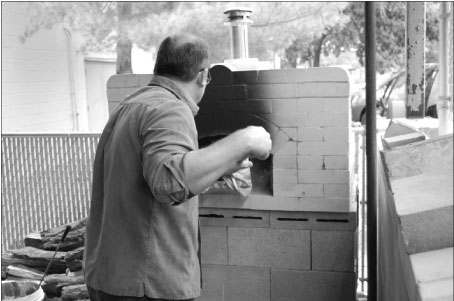
His classes stand out in a way that appeals to many college students. While ceramic items are being fired in the kiln, pizza is being cooking in a miniature kiln nearby. This brings a unique sense of community to the ceramics department. While students do hands-on work, taking turns stoking the fire for their ceramic items, they also eat pizza and socialize.
“The first pizza we made was expected to be a disaster,” said Burns. “When it came out so beautifully, it became a no-brainer that this should become a tradition.”
The pizza kiln was created from leftover bricks and mortar after the creation of the wood-fired kiln.
“It’s nice to have pizza and relax with friends, especially after putting 15 or so hours into my work,” said Patrick Rademaker, a sophomore ceramics major. “I think it’s just so innovative—the way we created the pizza kiln and the way it brings us together.”
Reese Salmon, a junior 3-D studio arts major, describes the atmosphere in the ceramics class as a family environment.
“There are many of us that bring food together to share,” said Salmon. “We take coals from the wood kiln and put it into the pizza oven to bake bread, pizza or anything else. It’s an interesting addition to what we have here.”
While most students on campus swipe their meal cards for a quick lunch at Papa John’s, ceramics students enjoy Neapolitana pizza, with specially made dough that allows it to cook quickly in a kiln.
Gilbert Mitchell – math pathways
Although Kentucky is generally a rural state, U of L is definitely an urban campus. So when Gilbert Mitchell, a math pathways professor, shares stories of his early life on a farm with his students, he can’t help but feel a sense of pride in knowing his experience is unique.
Mitchell grew up in Washington County, where he spent his childhood years doing chores, milking cows, completing homework by the light of a kerosene lamp and using an outside bathroom. It may seem quirky or odd to some, but to Mitchell the simple way of life was best.
His family eventually moved away from Washington County and into the Highlands because his father couldn’t make a living on their farm anymore. Mitchell graduated from Louisville Male High School and eventually obtained a master’s degree in mathematics from Spalding University.
“I didn’t like anything about it,” Mitchell said about his transition to city life. “I wasn’t allowed to go outside and play. All the houses were side-by-side. I didn’t like it at all.”
Mitchell now owns a five-acre farm in Boston, Kentucky, complete with a John Deere tractor and dozens of chickens. To this day, he continues to grow an organic vegetable garden every year, giving away a large portion of the crops to friends and neighbors in need.
“This was all before being green became popular,” said Mitchell. “The farm is just a nice place for me to go and relax and get away from the busyness of the city.”
Mitchell hopes that his students can learn from the farmland stories he shares in class. He wants them to see that there is nothing too strange or quirky to pursue in life, as long as they love doing it.
“I just want them to have confidence in themselves,” said Mitchell. “If I can encourage students to believe in themselves, there are no limits.”