

 By Michael Kennedy
For many students, the days of carrying a heavy backpack to class may be numbered. Advances in technology, including e-books and the Apple iPad, may make it easier, safer and more convenient to carry textbooks.
According to the Consumer Product Safety Commission, there are over 20,000 backpack-related injuries annually, most affecting backs, necks and shoulders. The risk of injury is increased if the backpack is too heavy or worn over only one shoulder, said John Nyland, University of Louisville associate professor in orthopedic surgery. He said backpacks should not weigh more than 20 percent of the user’s bodyweight, and never more than 25 pounds.
According to Nyland, backpacks may pose other less obvious risks to students, as studies have indicated that backpack users are more prone to misjudge distances and elevation changes, making road crossings more dangerous. Backpack users are also more susceptible to blisters, and should condition themselves before carrying heavier loads.
The risk of injuries from heavy backpacks could all be changing with the growing popularity of e-textbooks. Publishers are embracing the format, since there is little marginal cost for each book. For students, e-textbooks cost less than traditional textbooks.
Daniel Gower, a freshman computer engineering and computer science major, has had favorable experiences with e-textbooks.
“It worked out pretty well for me,” said Gower. “It was pretty easy to get, because you could just go online and download it. It was cheaper than actually buying a real textbook.”
McGraw-Hill Education has 95 percent of its current textbooks available online as e-books, at 55 percent less than the cover price, according to spokesman Tom Stanton. McGraw-Hill Education, along with numerous other textbook publishers, founded CourseSmart, an e-book marketplace now offering over 9,000 e-textbooks.
“CourseSmart was co-founded by Pearson and other publishers, to give students a reliable, cost-saving alternative to print books,” said Susan Aspey, spokeswoman for Pearson Education.
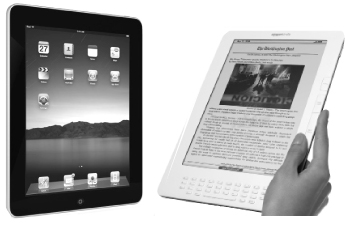
CourseSmart recently released an Apple iPhone application, which allows students to download e-books directly to their mobile devices. While the iPhone may provide the ultimate portability for textbooks, publishers have joined forces with ScrollMotion to design interactive new textbook applications for the iPad. Meanwhile, Amazon has been marketing the Kindle DX as a portable textbook reader, and has e-books from the major textbook publishers available for it. Both readers allow students to highlight and take notes directly on the pages of the e-book.
Not all students are excited about e-textbooks. Charles Manzullo, a sophomore pre-med student, said he probably won’t buy an e-textbook.
“I like having the in-hand thing better,” Manzullo said. “I like being able to physically hold the book, rather than having to look at it on a computer monitor. That just kills my eyes.”
Manzullo said the price of e-book readers are a turnoff to some students, and said they would be more attractive with a lower price. The base model iPad will cost $499, while the Kindle DX costs $489.
“I think it could be something [students like], but I think it depends on what the price range would be,” said Gower.
Until e-books achieve ubiquity, students concerned about the weight of their backpack have more low-tech solutions. According to Stanton, McGraw-Hill offers paperback editions, along with loose-leaf binder editions and custom published products – some of which may be abridged versions of a longer textbook.





