 By Michael Kennedy
On March 21, the United States House of Representatives passed two pieces of legislation that will affect most college students. While comprehensive health care reform will create the most enduring changes for college students, the student financial aid reform will have the most immediate impact.
After the House passed the Senate’s health care overhaul bill, it voted on a reconciliation bill, packed with changes the House wanted to make to the Senate’s bill. In addition to those changes, the House voted on the Student Aid and
Fiscal Responsibility Act, also known as SAFRA.
The health care bill passed the House by seven votes and the reconciliation bill passed by 13 votes. Louisville’s representative, John Yarmuth, was the only Kentucky congressman to vote for either piece of legislation.
Yarmuth said both pieces of legislation will benefi t college students. He said students could stay on their parents’ health insurance plan through the age of 26, an increase from the current age of 22.
“Of course, the health care bill itself is a remarkable advance for college-age Americans because it basically says that now they can stay on their parents’ policy until they’re 26,” said Yarmuth. “At an urban university like Louisville
where you have so many nontraditional students, you have lots of people in that 22-plus category. This becomes a real important change.”
Senator Jim Bunning of Kentucky joined the rest of his Republican congressmen in unanimously opposing both bills.
“Overall, this [health care] bill is a recipe for disaster for our country,” Bunning said in a statement. “It is nothing more than a two-and-a-half-trillion-dollar scam that will bury future generations of Americans under mountains of
debt. The so-called fixes that were passed by the House last night and will be considered in the Senate this week only make an already bad bill even worse.”
Phillip Bressoud, executive director of Campus Health Services for the University of Louisville, said he doesn’t anticipate any changes to the health insurance plan offered to students.
“We’re trying to begin to feel what kind of effect it will have on university-sponsored insurance plans,” said Bressoud.
He said U of L students already cannot be declined for a pre-existing condition, a stipulation in the health care bill that passed the House.
“So far as we know, we’re at or better than what’s going to be mandated, as far as pre-existing conditions,” Bressoud said.
For uninsured students, U of L’s health insurance plan costs about $2,000 a year and is open to any student taking six or more credit hours. Bressoud said Campus Health Services hopes to keep the cost at the same level for next year.
Leading the fight against the Democrats’ health care reform bills was Mitch McConnell, Kentucky senator and Senate minority leader.
“Just one day after the president signed this bill into law, we got word that one of its celebrated nearly features — a ban on discriminating against children with pre-existing conditions — won’t immediately protect children after all,”
McConnell said in the Republican address on Saturday, March 27. “Another promise, requiring insurance companies to let young adults stay on their parents’ plans up to age 26, turned out to be similarly ineffective.” In an effort to
reduce the costs of the health care bill, Democrats added SAFRA as part of the reconciliation bill. It was approved by the House in September, but was never able to get the necessary 60 votes to pass the Senate. Under the reconciliation
bill, it would only need 50 Senate votes to pass. SAFRA received 56 votes to pass the Senate.
Under SAFRA, students will no longer receive fi nancial aid through private lenders. Most student loans will come directly from the federal government through the direct loan program.
In the past, the federal government subsidized student loans up to 1.5 percent for private corporations who lent students the government’s money. In addition, the government guaranteed the loan. Under the new program, the government will
make loans directly, reinvesting much of the savings into Pell Grants which do not have to be repaid.
“By putting everything on a direct loan basis, the CBO—the Congressional Budget Office says it saves 61 billion over 10 years, saves the taxpayers,” said Yarmuth. “And that’s the money that’s going back into increasing Pell Grants.”
Yarmuth explained that the maximum amount of a Pell Grant will increase from $5,500 to almost $6,000, with that amount increasing with inflation.
Mike Abboud, associate director of financial aid at U of L, said students who are borrowing money through U of L’s Staff ord Loans will not see any changes. He said U of L switched from private lenders to the federal government in 2009.
“Our students are not impacted by that [law] because we made that switch in 2009,” Abboud said.
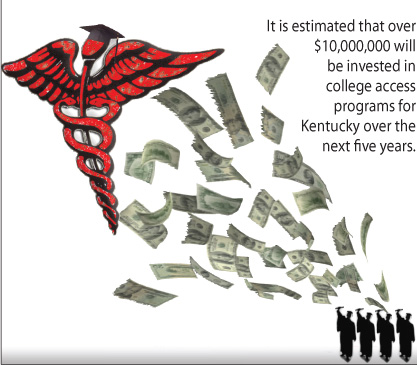
The House Education and Labor Committee estimated that over $10,000,000 will be invested in college access programs for Kentucky over the next five years.
“The legislation has additional money for college access programs too, which I think for a state like Kentucky those are important,” said Ted Franzeim, a spokesman for the Kentucky Higher Education Assistance Authority and the Student
Loan People.
KHEAA and the Student Loan People are nonprofits chartered by the Kentucky General Assembly to assist Kentuckians with college enrollment.
Since their loans are no longer guaranteed and they are not receiving a subsidy, private lenders are expected to decrease the amount they lend. Still, Franzeim doesn’t think students will have a problem getting loans.
“From a student’s perspective, I don’t see a disruption in a student’s ability to get loan funds – so that shouldn’t be a problem,” said Franzeim.
A spokeswoman for Fifth Third Bank, a private lender of student loans, declined to comment, saying “we’re not familiar enough with it ourselves yet.”
“Companies such as Sallie Mae and Nelnet have already talked about that they’re going to be cutting workers at their companies based on the fact that the need for a [private] lender is going down,” said Abboud. “At the same time, part of
the reconciliation act discussed that there are going to be servicing contracts – because the government’s not going to be doing all this on their own. They’re essentially outsourcing some of the work.”
Under the new law, no one will be required to pay more than 10 percent of his or her discretionary income toward student loan repayment. Right now, that amount is 15 percent. Student loan forgiveness will occur after 20 years of
repayment, rather than the current 25 years. These changes affect all loans