 By Whitney Spencer
For the past year I’ve had the unique opportunity to sit courtside in one of the most historic arenas in the country: Freedom Hall. As a member of the media this season, I have yet to enter Freedom Hall through any entrance besides the one marked for the media. I’ve had the privilege of crossing paths with the likes of new head football coach Charlie Strong and world-renowned boxer Muhammad Ali. Still, my favorite part of Freedom Hall may be the rich history that the building holds.
Recently, I had the chance to take a behind-the-scenes look at the inner workings of Freedom Hall several hours before tipoff. As I entered the back of Freedom Hall like I have so many times before, I felt grateful for the opportunity. Kenny Klein, senior associate athletic director, led the way. We first traveled through the training room and into the locker room. Usually this room is filled with chatter and doused with the smell of sweat and cologne. But now it was empty, with jerseys spread across the chairs in front of each player’s locker.
As we exited the locker room, we walked along the hallway covered with photos of Cardinal greats such as Darrell Griffith and Charlie Tyra. We entered the elevator that took us to the second level of the arena and into the suites. The donor suites aren’t too extravagant, but are just what you would expect from a historic building like Freedom Hall. A stained glass window emblazoned with the original Cardinal logo brought natural light into the room. Clearly I wasn’t the only fan in the room, as Klein walked over to an award propped on the wall and snapped a quick photo with his camera phone.
The president’s suite showed the age of Freedom Hall, as the room was blanketed with a dark red carpet and showcased dated photos on the walls. Although the modern tables and bar area showed that the room had been updated, I sensed that it had seen its share of people and events over the years. As we headed out through the concessions of Freedom Hall, I couldn’t help but glance out onto the floor from one of the entrance ramps. Hearing the echoes of the basketballs dribbling in an arena not yet filled with screaming fans was surreal. I usually struggle to hear the other reporters on press row, even those sitting next to me.
Next we entered a room filled with tables and lined with red and black tablecloths. Once again, the walls told a story of the past. Aged photos of former games in Freedom Hall and various team photos—from field hockey to soccer—lined the walls around the room.
As Klein and I stood in the room, I asked him his thoughts on the departure of Cardinal basketball from Freedom Hall. For the first time I understood the capacity of the history and personal ties. After 27 years of arriving at Freedom Hall five hours before tipoff, patrolling the entrances and locker rooms, Klein couldn’t help but smile as he ran back dozens of memories in his mind. Though he is ecstatic about the advancements coming with the new arena, he stated it simply, saying, “I’ll miss this place.”
We then ventured to the VIP suite. A large window showed the entire front entrance of the fairgrounds. This room, just like the earlier suite, was covered with dark red carpet and padding on the pillars. As we propped the doors open, a perfect view of the court showed. We received clearance to wander freely throughout the rest of building, to explore every inch of Freedom Hall.
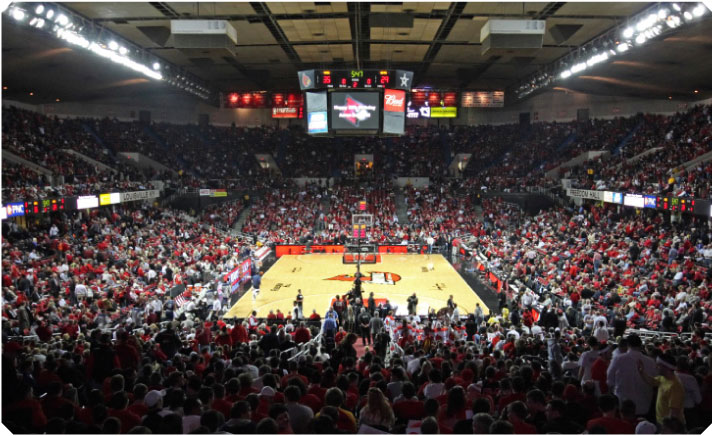
I took the opportunity to enjoy this building as just another fan, as I had my eyes set on the court. First I ventured through the seats of the arena, catching views from different angles and wondering what it might have been like to witness a few of the historic moments that have taken place throughout the 54 years.
I could imagine the ring in the middle and the flashbulb lights snapping continuously, as Ali gave his stunned opponent his famous laser-look. I thought about the thousands of screaming fans who watched as Elvis Presley dropped to his knees while strumming his guitar. And, like all game days, I began to anticipate the cheers from the Cardinal faithful, from tipoff to the final buzzer.
Finally, I made my way down to the Denny Crum Court. I’ve walked across this floor several times, as I covered women’s basketball during Angel McCoughtry and Candyce Bingham’s amazing season last year. But I had never been given unrestricted access to enjoy the moment.
I stood on the floor and had a conversation with one of the student managers of the basketball team, discussing the season and what was to come. Suddenly, a loose ball rolled to my feet. I grabbed it and took two dribbles, stepping just inside the 3-point line and launching the ball. It turned out to be an unsuccessful attempt, but my form was good enough for the manager to notice that I used to play basketball. When I realized where I was, I felt the excitement in the pit of my stomach. Did I really just take a shot in Freedom Hall? Granted there wasn’t a crowd of 18,000 watching, but the 20 or so people around were just fine for me.
Assistant coach Walter McCarty strolled out onto the floor. Our requests for a few half-court heaves were met with a barrage of shots from all over the floor. Soon several reporters looking to speak to McCarty met him on the sidelines. And the managers huddled together to talk about what needed to be done before warm-ups began.
Soon after, I took a seat on the sidelines and watched as the cameras were hauled in and players came to the court for shoot-around. Samardo Samuels worked on his shot from the free-throw line and Reginald Delk and Peyton Siva warmed up from behind the arc. It was an unreal experience to sit on the opposing team’s bench and watch.
As my time came to a close, I took one long last look at my surroundings. Though this wouldn’t be my last time in Freedom Hall, I knew it was a once in a lifetime opportunity. I would be back later that night to see the Cardinal mascot warming up before he led the team out of the tunnel. I’d see the team huddle together with words of inspiration and prayer before they took the floor. But it’s the simple moments that I knew I’d remember.
It’s the bouncing of the ball and the echoes sent throughout Freedom Hall that I’ll remember. It’s the squeak that shoes make when a sharp cut or turn is made on the floor. It’s the rich history and the ghosts of big shots that will live on. I will forever remember Edgar Sosa’s dagger against the University of Kentucky and Earl Clark’s monster jam on top of the University of Notre Dame’s Luke Harangody.
As soon as all the hype dies down and the final buzzer has sounded, Freedom Hall will go on. The Denny Crum Court will be lifted and room will be made for the next event. Students will walk across Freedom Hall in their caps and gowns and thousands will still catch a horse show or concert inside. No, there won’t be a Cardinal in the middle of the floor, but there will always be the opportunity to make the history of the building just a bit richer.