 By Elijah Mckenzie
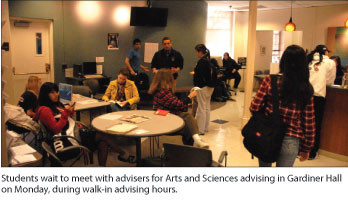
It’s 9 a.m. Monday, Oct. 26, and students are sitting on the steps in Gardiner Hall. Registration began today for non-honors undergraduates, and dozens of students are waiting to speak with their College of Arts and Sciences advisers. There are no appointments, everything is done on a first-come, first-serve basis.
Walk-in advising ranges from Oct. 26 to 29, and Nov. 2 to 5. It allows advisers to assist students in need of immediate attention, either for general academic advice or for advice on registering for classes for the next semester. But despite the Advising Center’s open doors, there are other aspects of advising that students tend to find complicated and confusing.
“The responsibilities of the advising, registration and admissions offices tend to overlap in their relationship with students,” said Meg Rohmann, assistant director of the Arts and Sciences Advising Center. “Since the procedures of those departments blend together, it often confuses students, making them wonder what they’re required to do next.”
Advising is a mandatory process for students with less than 24 hours earned, and for students with 45 or more hours that have yet to declare a major. This applies to both residents and transfer students.
History major Ashley Glenn, who transferred to the University of Louisville from Elizabethtown Community College, struggled to keep her credits eligible when she worked with her adviser.
“When I moved to U of L, the advising office told me I had 10 extra credits that were able to transfer over, which led me to believe I was further along than I thought,” said Glenn. “When I returned to the advising office to register for classes and apply for my major, I was told that those 10 credits didn’t actually count and, as a result, I was set behind.”
The Arts and Sciences Advising Center accommodates incoming transfer students, getting them involved with an orientation session and allowing them to register during the early registration period. But since different schools have different admissions requirements, it can become easy for students to get frustrated with the overall transfer process.
Glenn’s unfortunate experience, which happened early in her career with the university, supported her certainty that departmental advisers needed to be on the same page as undergraduate advisers, to avoid confusion.
This sentiment is not isolated to the College of Arts and Sciences. Mason Bryant, a junior mechanical engineering student in the Speed School of Engineering, shared the same opinion that students should keep a consistent adviser throughout college.
“My first adviser kept me well-maintained on courses, helped me out on what I needed to do, and made sure I was in the right classes,” said Bryant. “She knew who I was, remembered that I played guitar, and just made the whole experience personal, rather than thinking of me as just a number.”
Bryant’s confidence in advising waned slightly after he decided to enter the mechanical engineering discipline.
“After I chose my department, my adviser changed and I was moved to a more department-specified person,” said Bryant. “My first adviser knew who I was, my circumstances, and also knew what I was going for, so it slightly bothered me when my adviser changed.”
“Students feel most comfortable when they are able to work with the same counselor,” said Tomarra Adams, assistant dean and director of Advising and Student Services for the College of Arts and Sciences. “This seems to be one of the greatest frustrations in their advising experience, as it also speaks to the consistency of the information they receive.”
According to Adams, over the past five years the Arts and Sciences Advising Center has increased the number of advisers from 10 to 15, with three more hires to be made. This effort will attempt to place more emphasis on in-depth planning conversations between students and their advisers.
Bethany Poston, a senior humanities major graduating this fall, said she benefitted from one-on-one time with her departmental adviser, rather than general advising from the Advising Center.
“In my freshman year, I felt that I missed out on so much information after working with my first adviser, because I wasn’t given clear information on what choices would be the best ones to make,” said Poston. “After I was transferred to my current humanities adviser, I am kept up to date on events that I should know about.”
Despite the plan for a larger advising staff, students seem to feel most aggravated by the overall lack of communication from advisers.
“My first adviser, from the biology department, was never in his office when he said he would be and he never responded to my e-mails,” said biology graduate Stephanie Epstein. “So, for my first year, I had to register for classes without guidance, which resulted in me taking an unnecessary class.”
Epstein, currently working on her second undergraduate degree, in pre-accounting, originally started her college career at the University of Louisville but later studied at other institutions, such as Rollins College in Orlando, Florida. Upon returning to U of L, Epstein found that some of her class credits wouldn’t transfer.
“Two of the classes I took at Rollins wouldn’t transfer because they weren’t eligible,” said Epstein. “I was never given an explanation from advisers as to why they couldn’t count though.”
Ian Pugh, a sophomore music major, said poor information from advising resulted in him not getting into some classes.
“During my first semester at school, I didn’t know when advising sessions opened, and wasn’t notified when they did,” said Pugh. “I ended up taking my advising session later than I wanted to and thus, was not able to get the classes I wanted.”
However, Pugh volunteered the option that the responsibility of keeping informed and up to date may ultimately fall on the student and not the adviser.
“My best experience with advising was not repeating my worst experience,” said Pugh. “So the next time around, I made sure I knew the date for advising and got it early. It’s sometimes hard to tell if the problem with advising is the student or the adviser.”