 By Deanna Tran
When Black University of Louisville Summit 2006 participant Rudolph Spencer, a sophomore political science major, woke up early on the Sat. morning of Aug. 26, he was not expecting to be greeted by 70 voices shouting words of Zulu.
The Black U of L Summit was the first of four seminars to be held in the Horn Auditorium at the School of Business. Reverend Alvin B. Herring, Executive Director of The Muhammad Ali Institute of Peace and Justice, had attendees of the Summit greet each other in Zulu, a South African language.
“Repeat after me and turn to your brothers and sisters and say, ‘Sawubona!'”
“Sawubona” is Zulu for “I see you.” And those students and staff of the university attending the first Black U of L Summit saw each other as one community finally coming together to address imminent racial issues, express ideas for change, and to set goals towards eliminating these issues. The Undergraduate Students Helping to Recruit (USHR), the Society of Porter Scholars, and the Association of Black Students (ABS), sponsored the event.
Black U of L Summit co-coordinator and USHR student coordinator, Khala Granville, a junior communications major, said that interaction between existing social cliques of African-Americans on campus was little or none at all, and thus this Summit acted to, “facilitate communication and harmony between groups, students, and staff.”
The Summit’s second seminar, “The Rock Cries Out to Us Today: Achieving Community,” centered on developing a shared destiny by aligning to shared problems.
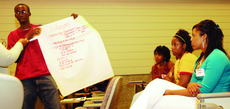
Student and staff participants were asked to list various struggles they have experienced on this campus – academically, financially, and socially. From the list of over 20 grievances, five were chosen to be the most prevalent problems that African-American students face here at U of L. The five included racism, material taught from white perspective, black on black relationships, lack of student involvement, and money issues.
Racism: When asked if anyone had ever been a victim of racism, all hands in the room went up. “Racism today is subtle, but it is still just as important to recognize and fix as it was back then,” said participant Lamar Braggs, the assistant director of student records.
Material taught from white perspective: Most agreed that the curriculum taught in school and in college lacked African-American history. “I wasn’t even introduced to African-American history until my sophomore year in college,” said participant Andrea Maron, a junior business major.
Black on black relationships: “Most blacks don’t feel secure in the black identity [that] the media portrays… so they have to bring others down,” said Keeley Copridge, a junior psychology major. Junior nursing major, Amelia Jackson, added, “The lack of community and communication are the biggest problems at U of L.”
Lack of student involvement: The body of students attributed this to the lack of encouragement, leadership, and commitment African-American students have toward campus involvement.
Money issues: The body agreed that there is a lack of awareness of how to attain and maintain scholarships offered to them.
Students and staff proposed a wide range of solutions to counter these problems. Solutions included creating informative Web sites and videos, generating a directory of African-American alums and professionals, projecting intellectual rather than physical achievements, holding campus forums, and seizing power through representation on executive boards and with student government candidates.
Collectively, these issues and proposed solutions created the first covenant of the Black U of L Summit. Participant Irving Joshua, chairman of the Department of Physiology and Biophysics, described this covenant as the need to provide “measurable objectives” in which future summits can return to and evaluate improvement and progress.
A Summit mixer, which included a motivational speaker, information fair, an exhibition of talents, and a dance followed the Summit in the Multipurpose Room of the Student Activities Center.
Black U of L Summit 2006 co-coordinator and President of the Society of Porter Scholars, Marchello Cavitt, a senior chemistry major, called the Summit, “a success. We’re meeting objectives and getting ideas out.”
“We want this to be annual and more specialized,” said Granville, who passionately spoke of the Summit’s future. Granville said that, “This is a diversity event; it’s all inclusive and requires the collaboration of many minority groups towards achieving these goals. These problems are not color-coded. It’s not just a black thing.”
For more information about the summit, or about the other sessions that will be held, visit the event Web site. It is available at at http://admissions.louisville.edu/summit.