

 By Lan Nguyen
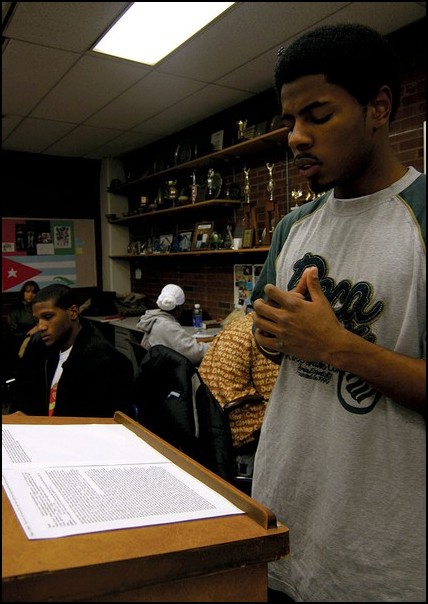
The University of Louisville debate team’s style is unusual, unorthodox and entirely new – but that hasn’t stopped them from finishing near the top in several major competitions this year.
The team’s goal is to create change within the debate community. Instead of the traditional Lincoln-Douglas debate, the team uses their own contemporary style called “Take it to the Streets.”
“Take it to the Streets” evolved from a project started in 2001 by Dr. Ede Warner, one of the team’s coaches.
“It’s a way to motivate teams and get the community to see and respect the value of our arguments to create social change,” Warner said. “Take it to the Streets” differs from the traditional Lincoln-Douglas style of debate in that, instead of having a trained, experienced debate judge watch and judge the debate, the team asks that a random person be “taken off the streets” and brought in to judge.
The purpose is that most debates are judged mainly by logic, but by taking a person from the community who knows nothing about debate, he or she tends to take into account emotions and credibility in addition to logic. It focuses on broad and diverse issues that encourage the participation of under-represented groups, especially African-Americans.
With “Take it to the Streets,” the forms of evidence are tailored to fit with and emphasize the culture of the debater.
“For example, if you were discussing violence in the black community you could use hip-hop music from artists who experienced violence first-hand. It’s important to incorporate [that in your argument] as well as academic evidence,” said freshman team member Jason Walker. Walker participated in debate during high school and was surprised by the U of L debate team’s style.
“It’s more educational and allows us to listen to different opinions and voices on an issue,” Walker said.
Teammate Deven Cooper, a sophomore was also involved in his high school’s debate team and found U of L’s style much more enjoyable. “In high school, it was more about winning. You had to read faster and present more information faster than the other person.”
Cooper especially likes that he can incorporate his personal experiences in the “Take it to the Streets” style.
“In traditional debate, we had had to read what authors and scholars felt because since we weren’t scholars or authors it seemed we had no credibility,” he said.
The team’s style doesn’t just attract experienced debaters. Junior and two-year team member Shauntrice Martin was intrigued to learn that the team used hip-hop music as evidence in debates.
“I rap outside of debate and thought if I could bring a part of me into an argument it’d be better than giving a boring speech that nobody cares about,” she said.
Warner said his idea of promoting diversity in a debate community that is not diverse has only caught on at a few schools.
“If the rest of the debate community would seriously do what we do and do it consistently, there would be more representatives of not just black, but Asian, Latino, etc., views.” With an increase in diversity, Warner believes that the community will see more of its own problems and more effectively find solutions for those problems.
“We’re doing this to achieve a larger change,” Warner said.





