

 By Tracy F. Harris
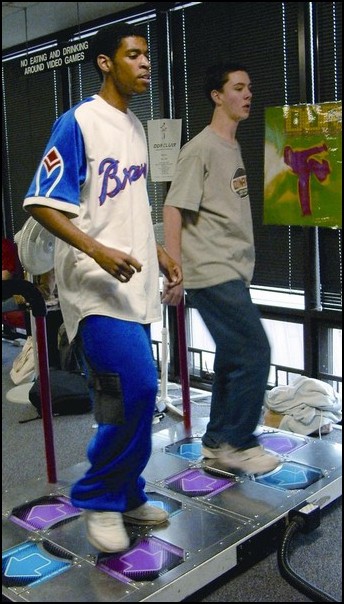
The Cardinal Game Room was just like a 1980s arcade with a new Pac-Man machine –– until Monday, Feb. 21, when the new Dance Dance Revolution machine had its premiere in the game room, and oddly giddy college students showed up to ogle and try out the new game.
Granted, the game room had had a DDR machine for some time. But it was a solo machine — one with only one set of pads — and then it broke.
Wait — let’s back up. For the uninitiated, Dance Dance Revolution is an arcade game formerly popular in Japan. Naamco brought the game to the U.S., where it soon gained a large following. The machine looks like any other arcade game, just with a platform in front. The platform has two blocks of arrows, four on each side: left, right, front and back. Players pick out a song and a difficulty level, then the game begins. Arrows scroll across the screen in a certain pattern, and when they reach the matching arrows at the top of the screen, the player steps on the matching pad. It’s harder than it sounds.
So, when the solo machine broke, the DDR Club at the University of Louisville was heartbroken. All its hard work would have to begin anew.
The club began in December 2002 with 20 members. The biggest event for the club that year, according to club president Adrian Grow, was a trip to the DDR-a-thon in Bloomington, Ind. The club took first place in the team tournament there.
The club then began discussions with U of L’s Intramurals department about purchasing a machine. To fund the purchase, the club held a number of fundraisers including a 100-song dance where sponsors pledged a penny per song and Grow played 100 songs on a DDR machine.
The club purchased a solo machine at that point, but players were still yearning for a double. The problem, Grow said, is that production of DDR machines ended at the beginning of 2003. New machines had to be shipped from Japan, Naamco’s home country, but the craze had died out there.
“Japan moved on to bigger and better things,” Grow said.
The loss of the solo machine waylaid the club’s plans and because of that, they haven’t met since the end of last semester. Finding a new machine took longer than Grow wanted, but he’s pleased with the result.
The new machine stands at seven feet of pulsing-light glory behind the pool and ping-pong tables: a DDR Third Mix in nearly perfect condition.
“It was the secret machine of Louisville,” Grow said. “The pads are in phenomenal condition.” It had been tucked away in a rundown hotel on Bardstown Road and never used. Grow was able to get a good deal on the machine and bring it to a more loving home.
He also did it in secret. He didn’t announce to the club that a new machine had been purchased; he even went to great lengths to ensure secrecy. He said he finally dropped enough hints that club members figured it out.
On Monday, at least 15 people showed up for the new machine’s debut. Grow invited a number of aficionados out; several were from other schools, and two of the state’s best players were in attendance, Grow said.
The intercollegiate attendance was part of what Grow and the club are hoping for. One of the reasons the club wanted to have its own machine was to revive the following.
“The [DDR] community in Louisville has been dying out,” Grow said. There are few tournaments and the other four machines in the city are overpriced and always busy.
Grow wants to make the machine available for tournaments and other events. Like the club did with the solo machine, Grow hopes to rent the new machine out for special events.
The locations of other machines in Louisville are another reason why the club needed to replace its machine.
“While we appreciate the machines in town,” Grow said, “there’s too much noise.” He pointed out that playing DDR requires being





