 By Dylan Lightfoot
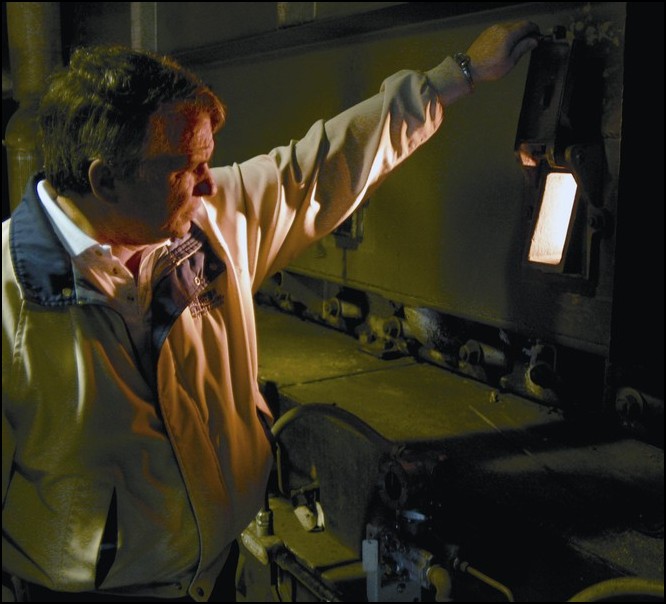
At this moment, in an unassuming brick building by the Warnock Street railroad crossing, a handful of physical plant employees are dumping a load of coal into an enormous boiler three stories tall, and watching the gauges that monitor its vital signs.
Ingesting the coal — high-quality, low sulfur fuel from Eastern Kentucky — the boiler self-ignites. As the glowing hot fossil fuel is conveyed though the boiler at a crawling 25 feet per hour, water is pumped in through overhead pipes and presently boils into massive volumes of steam. At 125 pounds-per-square-inch pressure, the steam then travels through five miles of subterranean steam lines to the 47 buildings on Belknap Campus for which the University of Louisville’s steam plant is the sole provider of heat during the cold months.
The boilers and their tenders work from mid-October to mid-April. Associate vice president for Facilities Larry Detherage said of the steam plant crew, “These guys don’t just come in from eight to five and go home. … They keep it going 24 hours a day, seven days a week. They never shut down.”
Last year, the plant burned 5,700 tons of bituminous coal, producing 130 million pounds of steam.
U of L’s steam plant is a modern facility. Built in 1978, it bears no resemblance to the stock image of a coal plant. There is no gang of stokers, stripped to the waist, covered in black dust and heaving shovels full of coal into a huge iron furnace. In truth, the plant is a sophisticated, relatively clean and largely hands-free operation.
Despite its proximity to the railroad, the steam plant’s fuel is delivered by dump trucks. The coal is dumped through a pavement-level steel grate into an underground hopper. An enclosed elevator system then shuttles it into an overhead bunker of 350 tons capacity. From there, gravity does all the plant’s material handling, the ash from the boilers finally spilling into a hopper on the lower level, where it is vacuumed off hourly into a silo for recycling.
The boilers are an efficient closed system, with 96 percent of all steam generated returning as condensed water to be made into steam again. The balance is made up with municipal water, but only after it has been processed through the plant’s water softening system.
The system is also cost effective. “It costs a lot more to burn [natural gas],” Detherage said. “You’re talking about probably two-and-a-half to three times more expensive than coal. Coal, right now, runs about $55-$59 a ton.” Based on these estimates, the cost of heating Belknap with coal last year was about $325,000, versus roughly $900,000 had gas been used.
That a university which aspires to become a thoroughly modern preeminent research institution by 2020 burns coal for heat may seem incongruous. But U of L is not the only university in Kentucky that uses coal for in-house energy. Western Kentucky University, Eastern Kentucky University, University of Kentucky and Morehead also burn coal.
Coal emissions remain a contributing factor to poor air quality throughout the state of Kentucky. In 2002, the Environmental Protection Agency rated Jefferson the worst county in the Southeast for hazardous air pollutants.
While U of L’s stack emissions are miniscule compared to other local coal plants — such as LG&E — the U of L Department of Environmental Health and Safety still reports quarterly to the Jefferson County Air Pollution Control Board.
EHS Assistant Director Dennis Sullivan said the plant stays in good standing with the board, and emissions are less than 100 tons annually for all pollutants but sulfur dioxide. But, Sullivan said, “We try our best to keep down SO2 by using high quality coal.”
From mid-April to mid-October, the plant switches over to its chiller circuit for cooling the campus. Water is chilled to 40-42 degrees using a hybrid evaporator/refrigerant system which can be seen sitting on the plant’s lower roof.
Once cooled, the water is pumped through classrooms and residence halls, where it draws off ambient heat before returning to the plant to be chilled again. The chillers’ output is enough to cool about 4,000 single-family dwellings.
Of course, the system isn’t perfect. The plant’s limitations become most apparent when the seasons change. Students and faculty regularly sit in uncomfortably warm classrooms as spring arrives, and dorm residents often complain that the heat doesn’t come on soon enough when cold weather sets in. This is because the nature of the physical plant’s heating and cooling systems doesn’t allow for rapid transitions between the two.
“It takes us at least a 73-hour turn-around to fire up the boilers,” explained Foreman David Veltman. “We have to be careful how we transfer loads.”
A comparable turnaround is needed to bring the chillers online. Then there is the time-consuming process of testing the boiler and chiller systems before use every season.
All of this means students and faculty may have to endure some discomfort for a few days each year. Belknap’s climate control isn’t designed for adjusting to the extreme daily temperature fluctuations that typify seasonal changes in the Ohio River Valley.
But few complaints from the campus community reach the U of L steam plant.
“I’ve heard maybe one or two in the past 15 years,” said Veltman.
Superintendent of Mechanical Services Dennis Keefe says he doesn’t hear many complaints, either: “They don’t care, as long as the thermostat works.”