 By Jordan S. Carroll
In the Frazier Historical Arms Museum there stood a man in full medieval garb, resting a longbow on his foot. He scowled as he described the Battle of Agincourt in a thick British accent and, at the end of his speech, flipped off the “Frenchies” with a reverse peace sign. Just an hour before the archer spoke, a Viking lord from the Battle of Stanford Bridge in 1066 dropped by. Decked out in a conical helm and chain mail hauberk, he described the last great battle of the Norsemen.
The Viking lord is Barrett Cooper, director of interpretations at the Frazier Museum. He and other interpreters or re-enactors give monologues and demonstrations daily at the museum.
“I have loved history since I was a child. I’ve always been interested in history. So being able to meld all of these loves I have — the acting, directing, combat and history — is just right up my alley,” Cooper said.
The interpretations cover a time span from the medieval period up to early 20th century. They focus primarily on American and European military history and range from Sir Thomas Mallory to Joan of Arc to Big Nose Kate (Doc Holliday’s mistress) to an American soldier at the Battle of Trenton.
In a recent interpretation, an actor performed as Colonel Robert Shaw of the 54th Mass. Regiment for Black History Month. The colonel, made famous in the film “Glory,” is notable for commanding one of the first “colored” regiments in the Civil War.
But the interpreters aren’t just actors. For this and other performances, the interpreters did heavy research to write the script, for instance, going back to Shaw’s original letters to his wife and parents. Using this rich primary source material, the interpreters make the historical figures come alive.
“Seeing that, even in dress rehearsal, the presentation of it, the appearance, you get caught up in the character and it really is a very emotional presence,” said Walter Karcheski, the museum’s curator.
In another interpretation, actors demonstrate Elizabethan swordplay using accurate historical replicas.
“Most of what [people] see these days tends to be glorified fencing which has absolutely no relevance to the type of [Shakespearean] sword-fighting that was going on. But in that context it gives us an opportunity to take in the world of Shakespeare,” Karcheski said.
The Frazier Museum will receive its first suit of armor in late spring and its second suit before the end of summer. The suits will be used to demonstrate 15th-century foot combat with hand-a-half swords, and will also be used in depicting the arming of a knight by his squire. Later interpretations will include exhibitions of the poleax as well as small swords from the 18th century and two-handed swords from the 14th and 15th centuries.
“We’re trying to find all these different ways of, number one, entertain[ing], but number two, and more importantly, to educate. A lot of people think that armor, if you fell down you couldn’t get up or that you needed to have a crane to get on your horse. That’s a total fallacy,” Cooper said.
The museum itself has numerous examples of armor and other weapons. The mainstays of the museum are the items from the Royal Armouries of Leeds in England and Owlsey Frazier’s collection of American arms. These even include Theodore Roosevelt’s impressive-looking double rifle, the “big stick.”
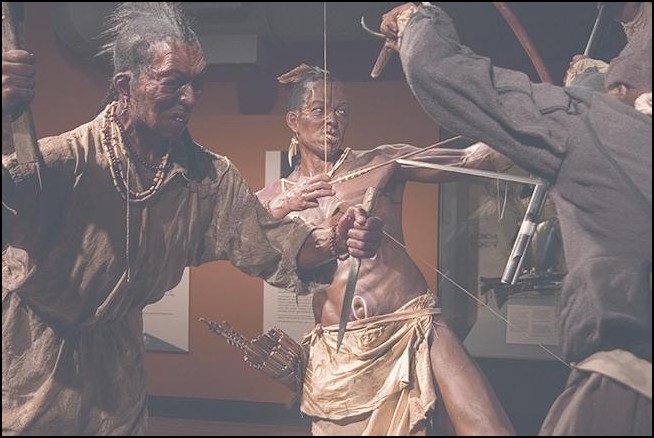
“I think that students coming here find that we’re not the sort of dusty jargon-filled text panel-type museum they might think of,” Karcheski said. “I think that by using modern technologies such as interactives, some of the tableaus, some of the graphic representations of things and the interpretive programs that we’re a bit of a departure.”
General admission is $9. Admission with a student I.D. is $6. The museum is open Monday through Saturday from 9 a.m. to 5 p.m. and Sunday from noon to 5 p.m.