 By Tracy F. Harris
“You have to look below the surface to find the women,” said Communication and Women’s Studies professor Cate Fosl, speaking in part about the civil rights movement.
Indeed, most stories and pictures of the civil rights movement are of African-American males fighting for equality.
“The men led, but the women organized,” Fosl said.
“They did a lot of the day-to-day work,” she added, namely, the background work that brought the groups together and organized protests and sit-ins.
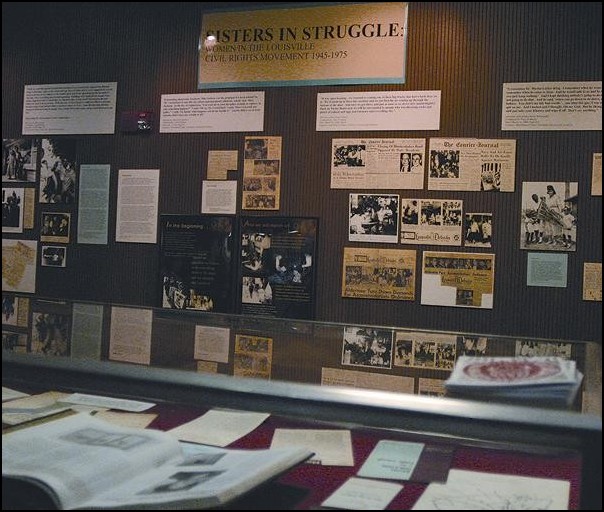
As part of Black History and Women’s History month, Ekstrom Library is featuring an exhibit, “Sisters in Struggle: Women in the Louisville Civil Rights Movement 1945-1975.” The exhibit, displayed on the lobby’s left wall, features history, photographs and biographies of notable Louisville women who played significant roles in the civil rights movement.
The exhibit is different than ones in the past years, according to History professor Tracy K’Meyer. Every year, as part of Black History Month, the library sponsors a civil rights exhibit. Usually, the exhibit focuses on the national movement and Martin Luther King, Jr. “That exhibit could be anywhere,” K’Meyer said.
David Horvath, the chair of the exhibits and programs committee, decided this was the year to not only localize the display, but to feature women as well.
“We realized that one of the missing chapters in the story of the local civil rights movement is that women are rarely highlighted,” he said.
In Louisville, he added, there were many women who were important to the movement, and the library wanted to showcase them.
The exhibit features information partially culled from interviews K’Meyer did in the 1990s. She moved to Louisville in 1995 and planned to research and write a book about women in the civil rights movement. She soon decided that Louisville was a fountain of female participation.
Louisville is different, she said, because women played a variety of roles. She said there were both African-American and white women, teens, nuns, lower-class and middle-class professionals; it was the “sheer diversity of women and the range of what they did” that made Louisville special, she said.
“It is just so much more diverse than what is commonly seen,” she said. And the exhibit does double-duty in this regard: “By focusing on women, you can bridge the issues of race and gender.”
The exhibit features a “purely local story,” she said. “People here don’t know how complex the story here was.”
Featured on the wainscoted wall of Ekstrom Library are Anne Braden, Gladys Carter, Ruth Booker Bryant, former congresswoman Georgia Davis Powers, Suzy Post, Mattie Jones and several others.
To go along with the exhibit, Ekstrom Library hosted a lecture on Feb. 3. According to Horvath, about 40 people attended the lecture.
“Tracy [K’Meyer] and Cate [Fosl] did a historical framework for the exhibit by talking about the civil rights movement in Louisville and the role of women,” Horvath said.
K’Meyer spoke about some of the women she had interviewed as a part of her lecture, “Unsung ‘Sheroes’ of the Louisville Civil Rights Movement.”
Fosl talked about women in the civil rights movement on local, regional and national levels in her lecture, “Women Working Against Racism and the South: A Historical Overview.” She pointed out that while women were overly represented in many social movements, there wasn’t a lot of coverage of them in the media.
Looking at old newspaper clippings and books, she said, gives the impression that the civil rights movement was male-dominated. The problem was that most of the reporters were male, as were the heads of the organizations, she said. The reporters had to look no further than the man in charge, and they didn’t.
It wasn’t until the women were arrested that they appeared in the media, K’Meyer said. And that happened with some regularity.
“Police treated [women] just as badly as the men,” she said. Women too were thrown in jail and dragged down stairs.
Fosl also spoke about the role white women played in the civil rights movement. Fosl is the author of a biography of local heroine Anne Braden.
“Not every southern city had a white woman who was such a spark plug,” she said, referring to Braden’s ability to bridge the gaps between men and women, blacks and whites.
The white people involved in the civil rights movement became allies of the blacks, she said. “It was an African-American movement and the white people involved knew that,” she said.
Both K’Meyer and Fosl said what they thought was most important about the exhibit was that it should be a source of inspiration.
Fosl pointed out that “freedom is a fragile thing” — there are many racial problems facing Americans today, she said, and people think everything is “all better” since the civil rights movement.
K’Meyer, however, wanted women in particular to draw inspiration from the exhibit. Just like the variety of functions women performed and positions they held in the civil rights movement, K’Meyer pointed out that women today can do the same.
“They can do a lot of different things to affect history,” she said.
To supplement the exhibit, the library will also be hosting a panel on March 7 at 3 p.m. in the library auditorium. The panel, unlike the lecture, will feature some of the civil rights movement participants themselves.