 By Mallory Bowman
In media today, it’s hard to sift through the headlines and truly believe there are journalists who want to work for the public. Worse than that, it’s equally difficult for many people to believe that journalists have a set of ethical standards that they uphold.
I’m here to speak for the journalists who do have those ethical standards and are willing to exercise them in their profession. As a devout Christian, I’ve been told by some in the field that I’ll never make it as a journalist. “Journalism and Christianity don’t mix” is a statement that has resonated in my ears.
But I’ve gone outside my comfort zone to pursue the profession to which I feel I’ve been called. I made the decision that I was going to work in journalism at the tender age of 15. I received my first newspaper job working for a small weekly doing typesetting and secretarial duties. It wasn’t much at first, but it was an open door.
Through the years, I have wondered many times if my place is truly in journalism. So many of the topics that journalists must address are extremely controversial ones for a Christian to come face to face with; and believe me, if I didn’t believe I was called to this profession, I wouldn’t have followed it.
However, I have found that there is a place for the Christian in the world of journalism. Of course, the common accusation that my religious beliefs drive my work has been made -— in fact, it’s true. My morals and values do drive my work. But not in the way that most people think they do.
As a Christian, I have been taught to seek truth and fairness — to see everyone equally. This is where I feel I have a leg up in the industry. Do I believe in and support everything that I write about? No. But do I believe that everyone deserves a fair chance to speak? Absolutely. And above all, I believe intelligent people should have the chance to make informed decisions based on an unbiased presentation of facts.
At last weekend’s Kentucky Intercollegiate Press Association Conference, Leeland “Buck” Ryan, Executive Director of the First Amendment Center at the University of Kentucky, spoke on the importance of a free press to the democratic process.
Ryan, a career journalist and author, discussed some over-arching principles under which a journalist should work.
Those guidelines were the three “R”s: readership, relationships and righteousness. Ryan addressed readership and relationships as being key in a journalist’s career. Obviously, journalists can’t survive without readership; and if we have no relationships, we have no communication with readers.
But righteousness was the most resonant to me. Ryan cited this as one of the main directives a journalist needs. “I know that word may have a religious overtone, and for that I have no apologies,” he said.
He added that the First Amendment was made to get government out of religion, not religion out of government. In a world where so many call on a higher power, journalists need to realize that the basis of many lives is religion.
For that reason, I believe I have a snippet of understanding for my readership. Many people don’t agree with me that Christ is the way, but I can identify with anyone who has searched for meaning, purpose and truth.
A recent piece by Marvin Olasky in World Magazine sums up why the Christian can very well be a successful, fair journalist:
“The chasm between modern mainstream media and Christianity [seems] immense. … Mark McGuire of the Albany Times Union wrote that the gorge was inevitable because of ‘the conflict between religious faith and journalistic skepticism.’ He offered the hoary journalistic joke, ‘If your mother says she loves you, check it out.’ He concluded that reporters can’t take anything on faith, while Christianity is built on faith, so never the twain shall meet.
“That analysis is … flawed for one main reason: A major theme of the Bible is its repeated declaration that if your heavenly Father says He loves you, check it out. Why else would Luke stress … that he relied on eyewitnesses, that he had ‘followed all things closely for some time,’ and that his goal was to offer the recipient of his letter, Theophilus, ‘certainty concerning the things you have been taught.’”
I made my choice to commit to Christianity, and I’ve also made the choice to be a journalist. Some contend that the two don’t mix, but I believe it makes me a stronger journalist and a stronger leader.
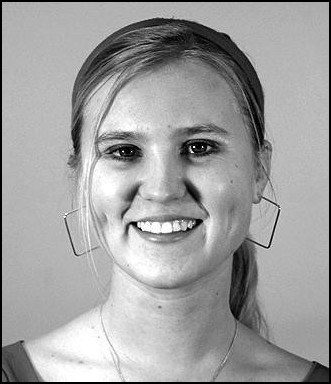
Mallory Bowman is a junior majoring in Communication and Editor in Chief of The Cardinal. E-mail her at: editor@louisvillecardinal.com