 By Mallory Bowman
It was a dream, a vision, a goal.
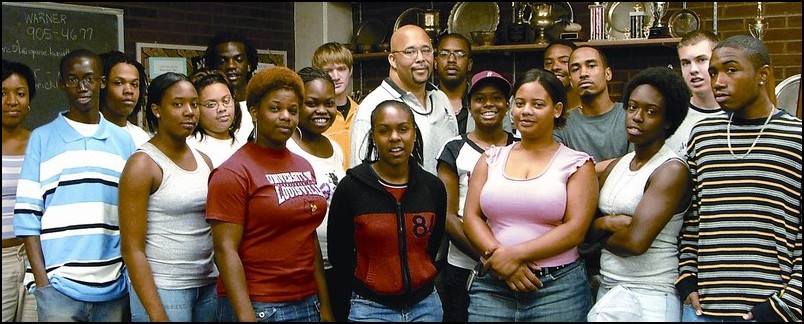
Dr. Ede Warner, professor and coach of the University of LouisvilleDebate Team, had a desire to help minorities, especiallyAfrican-Americans, rise above racism and hate. But at first, hedidn’t know how to go about it.
Warner has been coaching debate at U of L since the fall of 1993.Prior to that he worked as a funeral director. That is where hisdesire began.
“When I went to get my Ph.D., I was working in Gary, Ind. asa funeral director,” he said. “I was burying a lot of14-, 15-, and 16-year old black youths. I wanted to help them.Empowering minorities has always been my mission. I just had tofind another way to do that.”
That is when Warner came to U of L. For his first seven years ofcoaching debate, the team’s approach was in the traditionaldebate style, which includes immense amounts of research and arigid competitive edge. Traditional debate competitions includespeaking at speeds that the untrained ear cannot understand. WhatWarner and his team were doing was traditional, but Warner feltlike it wasn’t serving a purpose.
“Ultimately, I was failing at achieving my purpose [ofempowering minorities],” he said.
It was in the fall of 2000 when Warner decided to change things. Hewanted to use the debate team as an instrument to empowerminorities. He wanted to bring personal experience alongsideacademia into the realm of debate, and that is exactly what hedid.
“We just changed the emphasis,” he said. “Upuntil that point, it was all about ?competitiveness.”
Warner and the team named their mission “The LouisvilleProject.” Determined to change the face of debate, Warner andthe team started incorporating rap and hip-hop music into theirdebates.
The team still did research, but instead of it all coming frombooks and the Internet, it came from the streets and personalexperiences.
“We engage people in our debates,” Warner said.”We are more g DEBATE
From Page 1
or less the social activists of the debate community.”
Debater Jennifer Harris said she immediately identified with theteam.
“I was in a class trying to teach traditional debate and Ihated it,” she said. “But I like this [U of L’s]style. It’s so much different because other schools are veryimpersonal with their arguments. At U of L, we go out and we talkto people. We use our experiences and the experiences of others toempower. We’ve built a family within this room.”
At first, it seemed as if the team’s efforts were in vain.Warner said that the team lost numerous times before judges beganto appreciate its new style.
“We were determined,” he said. “But there were alot of times when I wondered if I had made the right decisiontaking the debate team in this direction. We had to lose a lotbefore we mastered this style.”
Second-year debater Stephanie Mitchell said she’s neverregretted debating in a different style.
“That is what appealed to me,” she said. “It justrelates to who I am. Traditional debate doesn’t appeal tominorities. I think we build coalitions upon oppression. We mainlytalk about black oppression, but all people can relate tooppression in some way or another.”
Now, four years later, the debate team is still on the cutting edgeof national debate. Warner said that no other school is doingexactly what U of L’s debate team is doing.
“There really are no teams that compare right now,” hesaid.
The team caters mostly to African-Americans; however, Warner said,any race or ethnicity is welcome on his team.
“Where I think everyone fits on this team is that the methodwe use is so that anyone can come in and learn how to debate fortheir social location,” he said.
The debate team’s efforts have started to pay off.
Not only has the team been nationally recognized for its efforts onCollege Sports Television, it had two teams advance to the quarterfinals in the National Tournament in April. Warner said that theteam had not advanced this far since 1997, when it was still doingtraditional debate.
“Advancing that far was inspiring,” he said.”This is the achievement of my dream.”
Tiffany Dillard, a former debater and an assistant to the team,said she’s seen the team grow together and overcome toughobstacles:
“The fact that this type of debate isn’t largelyaccepted does make it tough,” she said. “Each change wemake is a struggle. But they [the team] have never backed down. Thechallenge is what motivates us.”
This year the debate team has 22 members, most of which arefreshmen and sophomores.
Warner said that although he knows he has a young team, they cancontinue to achieve the purpose of advancing minorities throughdebate.
The team’s regular season is scheduled to start Sept. 24 atGeorgia State University. “We’re young, but we can dothis,” Warner said. “There’s a long road ahead ofus, but I can see the pot of gold at the end of therainbow.”