 By Melissa Moody
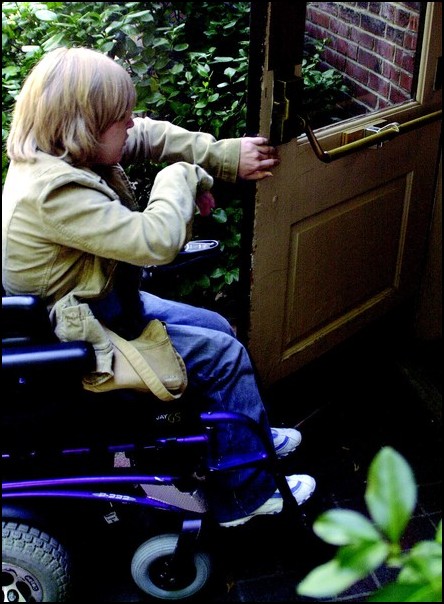
Amy Foster’s day doesn’t quite begin like most other students’. While sharing in the collective struggle to find parking, she has to find one of the few handicapped parking spaces which can at times be blocked. Getting to class is another story. When the sidewalk is blocked by construction, the average student can walk through the grass or take a different route. For Amy, it’s not so easy as that.
“It can be a real eye-opener to come to campus with a sprained ankle or broken leg,” explained Cathy Patus, director of the University of Louisville Disability Resource Center. “You have to rely on access features that not only make day-to-day life easier, but possible.”
People without disabilities, in their rush from class to class, often do not even notice the obstacles students with disabilities face. Is construction blocking the route from the SAC to Ekstrom Library? Well, walk a different route. Is a bicycle locked up on the stairs outside the Bingham Humanities Building? Most students just go up the other side, but a blind person cannot easily walk a different route, and a person in a wheelchair typically only has one entry option.
“For the most part, building accessibility, such as ramps and automatic doors, is good,” Patus stated, “Every student, however, is going to find places on campus that are problematic. It is ‘human error,’ which can be as problematic and more easily corrected, that we are trying to address.”
Human error, according to Patus, is identified as obstacles like bicycles locked onto wheelchair ramps and backpacks blocking classroom aisles.
“Often there are parked cars obstructing sidewalk ramps, or classrooms with desks crowded in front of the door,” Foster said. “The obstacles are not only physical, though. As a freshman it was hard to break through socially í- my wheelchair put people off.”
For some disabled students, misconceptions regarding their disability causes others to exclude them. “In group assignments during class, students don’t always welcome a disabled person, in the mistaken belief that they don’t have anything to offer or that their disability prevents them from making a contribution,” Patus said. “Exclusion is rarely intentional. It stems from a lack of awareness.”
Creating awareness is the first step, and communication is essential. Seemingly small changes, like considering access issues and being open and receptive to including students with disabilities, makes a substantial difference.
“Communication is really important, through the Student Disability Services office, faculty, students and facilities management,” said Huda Melky, ADA coordinator at Western Kentucky University. “Through internal communication we can keep students with disabilities aware of what is happening on campus and how it will affect them.”
Universities across Kentucky are dealing with these issues. Susan Fogg, disability accommodation specialist at the University of Kentucky, has been working at the University of Kentucky Disability Resource Center since 1976. “From that time to the present date it has been an exciting time,” she said. “With the implementation of Section 504 of the 1973 Rehabilitation Act and Americans with Disabilities Act, we have undergone a great deal of construction and remodeling to remove barriers for persons with disabilities.”
“There are, of course, still problems – we find that if building projects are not closely monitored, even in new construction, cost-cutting measures can eliminate a previously accessible feature or mistakes can occur.”
While these issues point to architectural barriers, students on both the UK and WKU campuses face similar impediments caused by what Patus termed “human error.” All three universities are making an effort to encourage individual students to recognize what they can do to improve access issues and increase awareness.
The U of L Disability Resource Center works with approximately 500 students a year, and accessibility issues are a constant struggle, according to Patus.
“It is the extra things that can make a valuable difference, such as being aware of potential obstacles, locking your bicycle off of the wheelchair ramp and keeping aisles and doorways clear,” she said.
“Each student can make a personal effort to minimize barriers, which does so much to foster a sense of inclusiveness. After all, anyone can become a member of this minority.”