By Sydney Ball
After 10 years away from academia, a voicemail led Professor Eve Polley to find their niche at the University of Louisville.
Polley has been an instructor at U of L since 2016, but was newly appointed to the position of Assistant Professor in the fall of 2025. Polley works in both the Department of Philosophy and the Department of Women’s, Gender and Sexuality Studies.
While Polley believes that a 10-year break was beneficial, they chose to return to graduate school in the spring of 2015.
Polley finds their passion
A decade prior, a professor of African and African American philosophy had left a strong impression on Polley.
Polley left D.A. Masolo a voicemail. Two days later, the mentor and mentee were meeting to discuss their return to the graduate program.
Under Masolo’s mentorship, Polley found themself researching African and African Diasporic philosophies.
Their other areas of research include ethics and epistemology.
Polley describes the study of epistemology as asking “How we know, what we can know, can we know anything at all?”
Polley believes that their inclination toward these subjects is rooted in their upbringing.
“I grew up in a religious tradition in which I was taught that basically everything was already known, and not only was everything already known,” said Polley. “But the rules for human behavior, what was right and what was wrong, were set in stone.”
In this tradition, women were also ranked lower than men.
As a teenager, Polley became skeptical about the ideas they were taught. In looking to learn more about the world beyond their upbringing, they were drawn into philosophy and feminism. Polley now teaches students how to be skeptical and think critically about the world.
Blending philosophy and WGST
In their course, Contemporary Moral Problems, PHIL 222, Polley encourages students to consider issues that are current and important.
Polley appreciates that this class is often taken by non-philosophy majors, allowing them to instill philosophical thought in a wide range of students.
While working as an instructor at U of L, they learned about an opening for a professor who would meld philosophy and WGST together.
“I was over the moon when I found out that I got the position,” said Polley.
For the first time this semester, Polley is teaching Women in American Culture, WGST 201. This course is an introduction to WGST. Students receive a slowed down, historical perspective of American women.

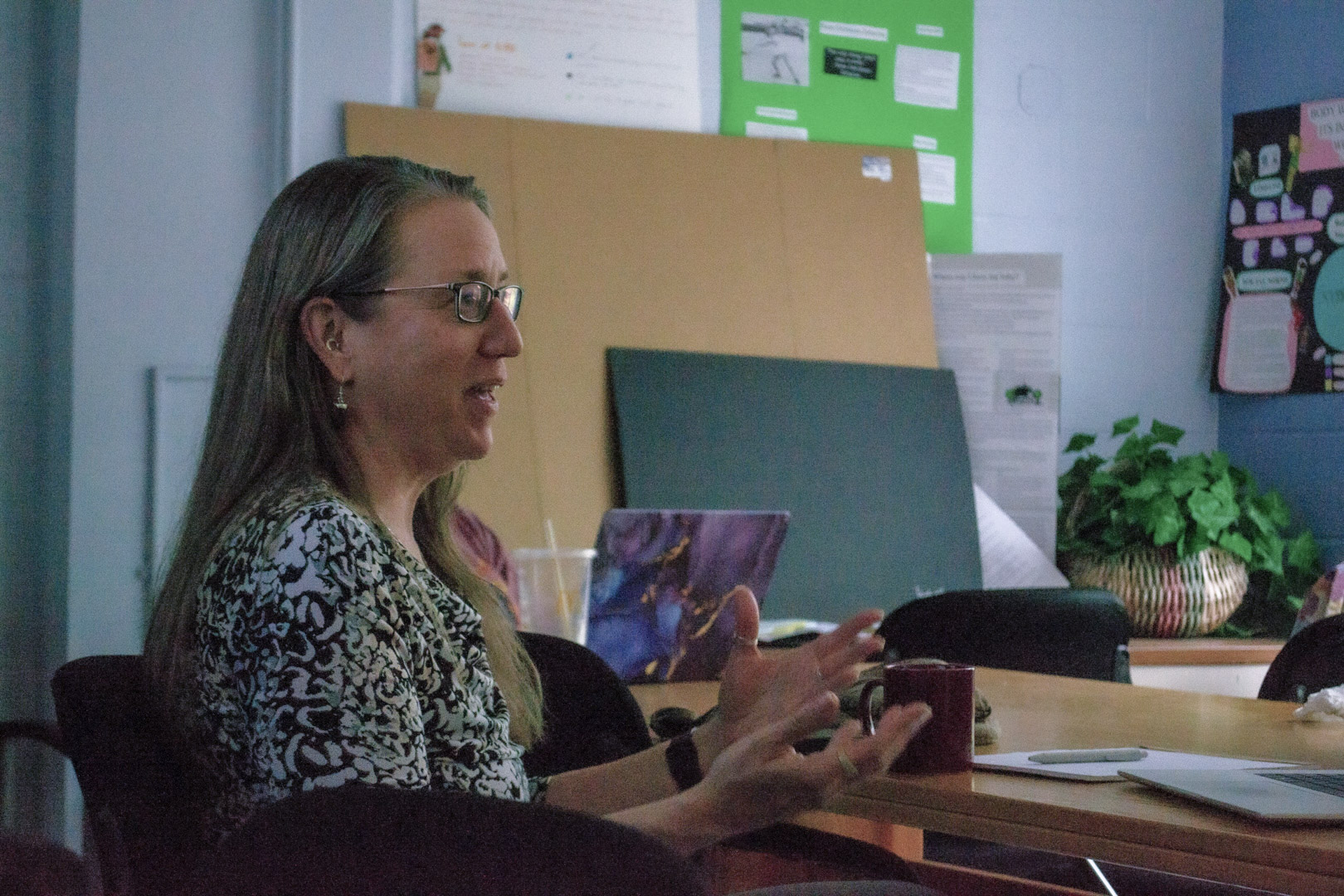
Students discuss their ideas on their final projects with Professor Polley (left). (Photo by Mel Banta / The Louisville Cardinal)
Polley said the course is important to understanding that many of the advances in women’s rights have been recent.
“These [social issues] persist into the present moment, and I think that it’s good to have an awareness of that history in order to address the problems of today,” said Polley.
Work in disability studies
To the Department of WGST, Polley brings a focus on disability studies.
Polley points out that many aspects of life can limit opportunities for disabled people. The disability studies program aims to encourage students to make life less isolating for others.
“Many students who are interested in creating a world, or at least helping to create a world, where more people are able to live life fully would be interested in disability studies,” said Polley.
They believe that students in departments across U of L already learn the ideas behind disability studies. To grow the program, Polley hopes to bring these students into a closer network.
The course, Bodies, Power and Difference: Feminist & Disability Perspectives, PHIL 505/605, WGST 591/691, also seeks to fulfill this objective. In this course, students consider the intersections of disability with other aspects of social identity from a feminist perspective.
To the Department of Philosophy, Polley brings their knowledge of African philosophy, which they learned from Masolo.
Next semester, Polley will impart this knowledge on students in a capstone seminar about Kwasi Wiredu, a prolific Ghanian philosopher: PHIL 502/505/557, HUM 561, PAS 557/657.
In this course, students will learn background knowledge on African philosophy and analyze selections from Wiredu’s books.
Polley is also contributing to a publication about the philosophies of Wiredu. The publication is in its editorial stage and, it too, will soon be ready to enter the world of academia.
Photo by Mel Banta / The Louisville Cardinal