 By Dylan Lightfoot
Lt. Colonel Jeff Lee of the U.S. Army Recruiting Battalion Indianapolis has been sleeping just fine at night. While the Army as a whole has lately seen a drop in enlistment, the unit under his command has been achieving its objectives.
“We’ve been very fortunate in this area [in that] we’ve been able to make our [recruiting] mission,” Lee said.
Lee’s battalion covers most of the Midwest, including the Louisville area.
But for most of the Army’s 41 recruiting units, the situation is not so rosy. According to Colonel Lee, recent shortfalls in recruiting quotas have left the Army short roughly1500 recruits per month. In the context of numerous base closings and the general movement towards what Lee calls “a smaller, smarter army,” this failure to meet quotas implies a very sluggish enlistment indeed.
Even with the Army tightening its belt, recruiters are resorting to desperate measures. “Quick ship” sign-on bonuses of up to $20,000 are being offered to recruits willing to ship out in one month. In spite of this, recruiters expect shortfalls to continue for the foreseeable future.
The problem is multi-faceted. Firstly, the Army is at war, which naturally slows enlistment. But other factors figure in. According to Lee, “The ‘Army of One’ campaign just isn’t working.”
Since the advent of the all-volunteer army 30 years ago, recruiters have faced a challenge, Lee said. Each succeeding enlistment-age generation is marked by social and psychological differences, and the Army spends tens of millions in advertising revenue trying to find new messages that resonates with them. The contract for the current “Army of One” campaign, held by a Chicago ad firm, is for $41 million.
The current target market for recruiters is “the millenials,” which Lee describes as those who have come of age since the millennium.
“These are young people who are technologically educated and globally oriented,” Lee explained. “They generally want to be part of something that’s bigger than they are.”
A generation considered by the Army to be ideal prospects would seem an answer to recruiters’ prayers. But the millenials are under the influence of “influencers,” a term recruiters have coined for parents, teachers, employers, etc., who hold sway over young peoples’ decisions about things like military service.
“Less than 15 percent of Americans now have served in the armed forces,” said Lee. “’The Greatest Generation’ is dying off…. fewer influencers are out there who might encourage [young people] to serve.”
G.I. shmooze
In April, a group of university and high school faculty from schools in Indiana and Kentuckiana were treated to an all-expenses-paid vacation to tour Fort Leonard Wood, Missouri. Major Coy Turner of the U of L Reserve Officer Training Corps [ROTC] organized a contingent of 7 U of L faculty members to join the tour.
The Army has been hosting such “educator tours” for several years now in an effort to give influencers in the education field a first-hand look at what the modern army is all about.
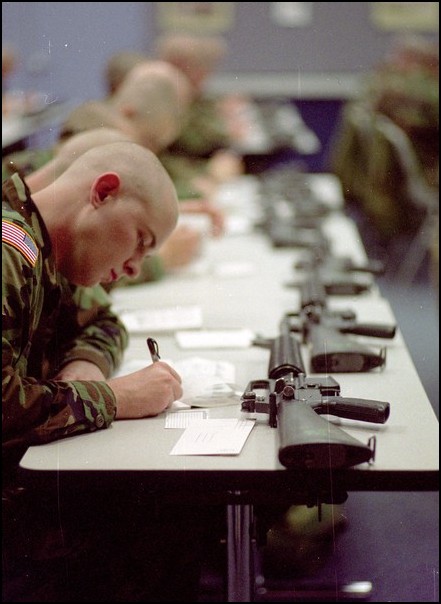
Tour participants were shown around the post, which is home to the Engineers, Military Police and Chemical Corps, where they saw various phases of basic and advanced individual training as well as dined with recruits.
Impressions were generally favorable among the U of L contingent. Julie Miller, a U of L admissions processor said, “I was extremely impressed….The Army has changed a lot and [is a] much more appealing army. It seems after talking to the new recruits that the [drill instructors] are much more in tune with the new people becoming a success.”
“It gave me an opportunity to observe the physical training and the educational process,” said Melvin Turner of the Minority Services Center.
But this reporter, who accompanied the tour, had mixed reactions. The Army may not be “your father’s Army anymore, but the official niceties of the tour could not obfuscate the hard facts of military service. The war-time atmosphere of a military base is palpably tense, and the rhetoric of recruiters always seems to dance around the Army’s real purpose.
But one Army sergeant, who asked that his name not be given, spoke frankly. As the tour passed though the barracks, he stated flatly that “all of [these recruits] will be going to war” Regarding that Army’s mission in the world today, he said, “Our job is to kill people.”
Costs and benefits of service
As an employer, the Army has a lot to offer. As of January 1, entry-level active duty pay is $1,142.70 per month.
Then there is the GI Bill. For fiscal year 2005, the Montgomery GI Bill is $36,144 for a four year enlistment. In addition, the Army College Fund pays a supplemental $30,600 for a total of $66,744 in college money.
For those already in college or about to graduate, the Army offers sign-on bonuses of anywhere from $2,000 for 36 hours of completed credits to $8,000 for a bachelors degree. They also will pay off up to $65,000 in federal student loans, and many graduates can enter service as officers.
Students also have the ROTC option, where monthly stipends and scholarships are available and graduation is, in effect, a commission.
But students who are considering military service should weigh the option carefully. While the Army does offer pay and benefits to rival most employers in the post-graduate job market, they come with a big commitment.
Cardinal News Editor and six-year Army veteran Charles Westmoreland said after his discharge last month, “If you don’t mind setting your personal beliefs, ethics and morals aside and serving someone else’s agenda in order to get ahead yourself – it’s worth it. Their ideals and lifestyle will become your own, anyway.”
“People that are going in now have to sacrifice more than they had to a few years ago,” he said. “The newest generation doesn’t remember what peace time was like, and who knows how long until we see peace again? The benefits are only worth it if you live long enough to use them.”