 By Eric Butler
Most of the university community knows that U of L prides itself on the breadth and intensity of research performed on its campus. Most of it is pretty self-contained, but there are plenty of studies conducted by university staff and faculty from a variety of departments which require the use of human subjects. At any time in the year one could conceivably find a handful of studies looking for participants, and perhaps even a couple willing to compensate them for their efforts.
It probably won’t be a huge amount, though. According to Dr. Paul DeMarco, an associate professor in the Department of Psychological and Brain Sciences, “If [the experimenter] decides to compensate then it must be commensurate with the perceived degree of inconvenience. … It’s minimal, maybe $10 an hour.”
DeMarco said it was actually illegal to overly compensate subjects to try to increase the incentive to be in the study. So for anyone looking for a quick buck, he advised, “You’d be better off donating blood, probably.”
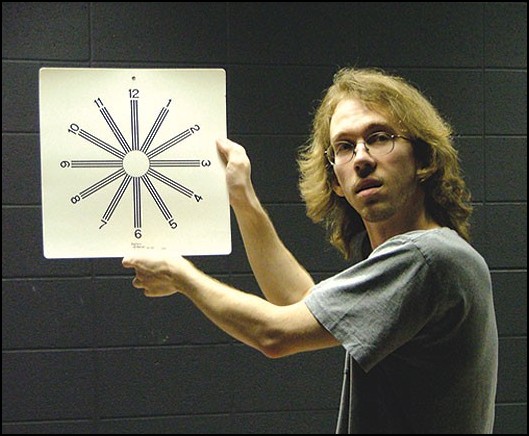
Still, 10 bucks for an hour’s worth of experimenting might sound pretty good to the stereotypically broke college student. That’s exactly what’s being offered in a study conducted by graduate student Andrew Haun and advised by Dr. Edward Essock in the Life Sciences Building. Their study on human visual processing is in need of individuals with normal vision (if you wear glasses or contacts it’s okay) to participate in 2 sessions of about an hour each. Subjects are compensated $10 for each session. Anyone interested in participating will have to visit Haun in LF307. As with all research projects, the specific details are kept hush so as not to introduce a potential bias or skew their data. Even for this story, a significant amount of description was cut due to potential over-informing.
It’s at least safe to say that participating isn’t in any way dangerous. According to Ellen de Graffenreid, who has a whopper of a job title — she’s the director for Health Services in the Office of Communications and Marketing — before any research study gets under way it is put under the scrutiny of the International Review Board and the Human Studies Protection Program Office to consider any risks that subjects might face during testing. Both of these groups must approve the study before it can be administered to human subjects, and their role in protecting individuals and minimizing risk extends throughout the study’s duration.
And even despite these external safeguards, if during the experiment the participant ever feels overly at risk, they have the right to quit.
“Research is completely voluntary and you may cease participation at any time without any consequences being suffered. It’s not a trap,” DeMarco said.
This is true regardless of the type of study, whether filling out a questionnaire, undergoing sensory examinations or getting involved in more in-depth or long-term medical testing.
An example of this last type of study — which is more appropriately referred to as a “clinical trial” — can be found at the Outcomes Research Institute at U of L’s Health Sciences Center. De Graffenreid said that there are often a number of these clinical trials going on in the Schools of Medicine and Dentistry and with other institutions at HSC. Currently, a study is under way to gather data about different responses to anesthesia and dental Novocain on individuals with red hair. De Graffenreid said that research on this subject has been under way for a year and a half and, through a series of double-blind experiments, genetic differences in redheads have been demonstrated. The present study is being done in conjunction with the School of Dentistry and is a continuation of these earlier experiments. They are looking for Caucasian male and female subjects with naturally red hair. Due to the study’s more demanding nature, compensation will likely be increased for participating, but no concrete number was provided. Interested parties can contact Terri Joiner at 852-2602.
If you’d like something tamer, head over to the CLC classroom in Ekstrom Library on April 6, 13 or 15 at 9 a.m., 2 p.m. or 9 a.m., respectively. This one isn’t even really a “study” so much as a pilot program to aid a company called ETS develop and calibrate their newest Information and Communication Technology software.
The program attempts to assess subjects’ “ICT literacy,” or how well they can use computer software to complete tasks and manage information. The test is presented as two back-to-back hour-long units where the program presents certain real-life scenarios that need to be “solved.” Anyone participating in this pilot is compensated $25 for their time and trouble. To register, contact Melissa Laning by e-mail at melissa.laning@louisville.edu.
It’s important to remember that this is not the same as the earlier, more academic studies. Regarding research-based tests like the visual perception and anesthesia studies, DeMarco said, “They’re not aptitude tests. The outcome is purely based on research and not to come to any conclusion about an individual subject’s performance. Under the research guidelines set up by the federal government we are required to ‘anonymize’ the data.” In other words, you’re there only to give them the data they need.
As a final word of advice, it should be mentioned that while the concept of relatively painless, single-session money-making is enticing, it is the function and moral duty of the research participant to give realistic data to the experimenters about how human subjects respond to their tests so that they can make important developments in their field of study. If you are interested enough to get involved with these or any other research studies and take their compensational money, please be respectful enough to carry out the experiment to the best of your ability. Happy testing.