

 By Billy S Garland
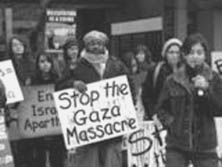
Monday a group of University of Louisville students stood beside Palestinian supporters gathered to protest the Israeli invasion of Gaza.
“This is our message,” Ibrahim Imam, U of L computer information and engineering professor said of the protest. “Communicated, hopefully, to a civilized society, that is willing to open its eyes and ears.”
Imam quickly clarified that he did not represent the university but rather was present on his own behalf.
“For my day job I teach at the Computer Information and Computer Engineering center,” Imam said. “Today I am standing here as an individual; as a Palestinian-American citizen not as a faculty member.”
The hour long protest was held at the center of campus and featured student speakers as well as several Palestinian citizens, intent on sharing their experiences. Said Salem was one such speaker hailing directly from the center of the conflict in Gaza.
“Today I called home to see how everyone was doing,” said Salem. “They said that my uncle’s house had been gunned down. It is now ribbons. My uncle’s house is gone. His business was downstairs. His Business is gone.”
Such personal testimonies of the destruction quickly raised the emotional tenor of the demonstration to a significant high. Later in the same speech, Salem depicted another scene through an emotionally strained voice.
“In one instance they gathered 10 or 15 families in one house. Then they shelled the house,” said Salem. “This is not a war, this is a Holocaust. If it is a war you don’t shoot civilians.”
It is this loss of civilian life that created some conflict about the protest. Shortly after Salem’s speech two Jewish students raised a sign in front of the crowd of protesters which asked the question, “If Mexico shot 20 Qassams a day into Texas what would America do.”
The question was a direct reference to the missiles launched by Hamas into Israel, continuously, since 2005. The counter demonstration was put to rest as one disgruntled Palestinian protestor approached the students and ripped their sign apart.
“The fact that they ripped our sign down and they won’t let us voice our opinion goes against everything this country is about. It is about freedom of speech,” Gariy Ocheretner junior physics major and one of the Jewish demonstrators said of the reaction. “Every country has the right to defend its own people. I was in Israel this summer and I was in the south where students have to have bomb shelter drills every day. CNN and the others don’t show that. They show the children being killed in Gaza, but there are children being killed in Israel by the bombs of Hamas.”
Despite the temporary disruption the organizers of the protest were able to maintain an impressive amount of control. One security official later commented that he was “…very impressed. We had a little conflict but nothing got out of hand.”
While the protest was kept peaceful, the war that served as a catalyst for the demonstration is anything but. Last week the death toll broke 1000 in Gaza and many of them civilian deaths.
“The toll now in Gaza is over 900 civilians, and the majority of them are women and children,” Imam said. “Let me remind you that this is only the numbers from the Hospitals; the people who could crawl to the hospitals. This is not the people that we will find when the Israeli attackers leave.”
The placards raised above the protesters heads all called for the end of the invasion and the removal of American support of Israel. Imam reinforced these sentiments as he revisited his speech in a later interview.
“The U.S. is financing what is going on. The Phosphorus bombs that the Israeli’s are throwing at Palestinians; burning the schools, burning the hospitals, burning them alive are actually U.S. financed, U.S. made armaments,” Imam said. “Unless we examine our consciences carefully and push for peace, the blood and atrocities happening there will be our responsibility.”





