 By Jennifer Hanley
Former Deputy Secretary of State discusses “The Russia Hand” at Ekstrom
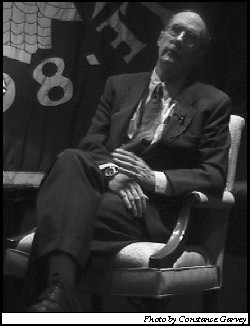
Strobe Talbott, Deputy Secretary of State under the Clinton administration, visited University of Louisville’s Ekstrom Library Auditorium on Wednesday, September 25, to talk about his new book, “The Russia Hand: A Memoir of Presidential Diplomacy.”
Talbott, author of books such as “The Russians and Reagan,” “At the Highest Levels: The Inside Story of the End of the Cold War” with Michael R. Bechloss, and “Master of the Game: Paul Nitze and the Nuclear Peace,” was invited to U of L’s campus to talk about his new book, which deals with US and Russian relations following the collapse of the Soviet Union. A guest of the Kentucky Author Forum, he discussed the public and private diplomacy between Clinton and Russian Prime Minister Boris Yeltsin and Yeltsin’s successor, Vladimir Putin, over such issues as nuclear arms, financial crisis, Kosovo and Chechnya.
Charles Ziegler, chair of the political science department, moderated the discussion, asking Talbott questions about the working and personal relationship between former President Clinton and former Prime Minister Yeltsin. Meetings between the two helped shape the crucial events of the 1990s following the break up of the USSR in 1991. Talbott describes the behind-the-scenes tensions as Yeltsin perilously managed personal relations with the Russian military and Parliament. Yeltsin was a troublemaker and was unstable at times, but Clinton acknowledged and accepted this. Clinton worked with Yeltsin despite an anti-American sentiment in Russia.
“Russians were did not like the US because we were making them eat their spinach by making them cooperate with NATO, IMF, and World Bank,” Talbott said.
Strobe Talbott was sworn in as Deputy Secretary of State on February 23, 1994. Talbott became involved in government after 21 years as a journalist for “Time” magazine. His last position there was the magazine’s editor-at-large and foreign affairs columnist. Prior to that, he was Washington Bureau Chief for 5 years. His earlier assignments for “Time” were diplomatic correspondent (1977-84), White House correspondent during the Ford Administration (1975-76), State Department correspondent when Henry Kissinger was Secretary of State (1974-75), and Eastern Europe correspondent for 2 years in the early 1970s.
Mr. Talbott twice won the Edward Weintal Prize for distinguished reporting on foreign affairs and diplomacy in 1980 and 1985. His contributions were also cited in three Overseas Press Club Awards to “Time”, in 1982, 1987, and 1989. As Deputy Secretary, he wrote occasional articles for “The Economist,” ” The Financial Times,” “Foreign Affairs,” “Foreign Policy,” “The New York Review of Books,” “The New York Times, Slate,” “Time” and “The Washington Post.”
Mr. Talbott served as a trustee of Yale University and the Hotchkiss School and as a director of the Carnegie Endowment for International Peace, The Council on Foreign Relations, and The Aspen Strategy Group. He was educated at Hotchkiss and Yale, graduating in 1968. Following his graduation, he spent 3 years at Oxford as a Rhodes Scholar. He is currently the President of the Brookings Institution.
While Talbott was present to talk about his book dealing with American relations with Russia, he spoke about the impending war against Iraq.
“The world will be much safer with Hussein gone,” Talbott said.
But he cautioned that there was a risk with applying the word “evil” in politics. He explained that while British Prime Minister Tony Blair was supporting the US in the on going saga of weapon inspections and threats of war, Bush and Blair wanted different things. Blair would be satisfied with containing Hussein’s biological, chemical, or possible nuclear threat, while Bush wants to get Hussein out of the leadership position in Iraq by any means necessary. Talbott warned against this idea of regime change because if Hussein felt like he was going to be removed from office once he complied with inspections anyway, he was not going to comply, driving the US to war without possible United Nations backing.
For more information on the Kentucky Author Forum, visit the website http://kaf.louisville.edu.