 By Tytianna Wells
Professors are using more new and advanced technological programs in classrooms which have become more popular over the years on college campuses. Depending on one’s major, students are exposed to a number of technical programs from PowerPoint to Dy Know and from projection screens to Bloodshed. These programs are designed to enhance the students’ academic classroom experience, thus aiding student engagement and overall, career development.
Moreover, many students agree technology in the classroom is academically beneficial for multiple reasons.
According to Demetrius Pryor, a freshman undecided major, technology programs are necessary in larger classroom settings.
“I am taking a history class and it is so big that [the professors] have everyone answer the questions at the same time with ‘Clickers,” said Pryor.
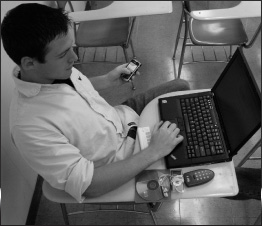
The Clicker is a small electronic device which is used to poll larger classroom settings. It allows students to send immediate responses for attendance, quizzes and exams during class.
James Johnson, a junior psychology major, said he also believes they benefit students by keeping them more engaged.
“Clickers are more fun than taking a quiz on pencil and paper,” said Johnson.
Not only does the student-teacher ratio affect the usage of technological programs in the classroom, but there are other factors which also determine its usage.
“Technology keeps the school updated, especially in my field,” said Troy Whitaker a freshman computer engineering major.
Dr. James Lewis, assistant professor of J.B. Speed School of Engineering, is one professor who is committed to keeping students up-to-date with the newest technological programs. One is the Dy Know program, which is an interactive tablet that transfers information, such as spreadsheets and graphic software, from the professor to students. This program allows students to retain class discussion and book notes from the professor.
“Overall, the presentations are much better than the chalkboard method,” said Lewis. “I am able to face the students while using the program, which makes the course more engaging for them.”
Although, the benefits of technological programs can span from making larger classes more efficient to simply updating teaching strategies; there is one issue in which both professors and students focus on in regards to tackling the diverse learning styles of students.
These learning styles include auditory, visual, tactile, kinesthetic, global and analytic.
Many professors take these learning styles into account because it aids the students’ academic development.
Johnson, a visual learner, is familiar with a number of technical programs in the classroom. “I learn better with visual presentations, rather than just hearing someone talk.”
PowerPoint is one program that has received strong opinions from students and professors.
“PowerPoint is a tool used to keep students’ attention,” said Xan U, a cultural studies TA, who is known for her vibrant, colorful and meaningful classroom presentations. “You have to give visual and audio information for a more vivid impression.”
Though many professors think that PowerPoint facilitates the learning process for students, freshman French major Alexandria Clark thinks otherwise.
“It puts me to sleep because they usually turn the lights off and read verbatim off the content,” said Clark who believes that professors should give examples of real life scenarios to engage students and to make the PowerPoint program more powerful.
Furthermore, technology in the classroom can prove to be beneficial or extremely distracting, according to students who mentioned that a professor’s level of familiarity with the technology used is crucial.
Johnson agrees that if the professor has difficulty accessing the technological programs in the classroom then class can be a “waste of class time.”
Not only do technological programs assist students with classroom lectures, discussions and assignments, but they also familiarize students with the programs.
According to Angel Sanford, a senior Pan-African Studies major, “I don’t know where I would be without technology.”
Heather Campbell, a sophomore accounting major, agreed with Sanford’s estimation of the importance of technology.
“I am hands-on,” said Campbell, who was recently introduced to the Blackboard program in her classroom. “I have learned how to access it and benefit from it.”
Though there are still questions and issues with implementing new technology in the classroom, few deny that such technological advances are here to stay.
“If you’re not with technology, then you’re not with the way the world is going,” said Whitaker. “You don’t want to be backwards with your education.”