

 By Jennifer Hanley
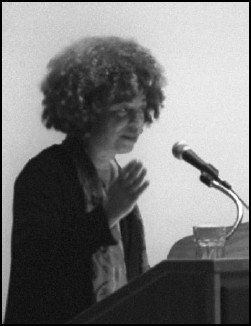
Activist and University of California Santa Cruz professor Angela Davis gave her first public talk, titled “Women in Jazz,” at the University of Louisville J.B. Speed Art Museum on September 19.
Tickets were hard to come by in the few days before the speech. A few people were given the opportunity to attend the talk because a friend could not go and gave them their ticket to the event. People were excited that the famous activist would be speaking.
“I love Angela Davis,” said junior Sara Stewart. “She is my hero.”
Others expressed that same sentiment after her speech in a question and answer session. A man from Denmark remarked how he also loved her and that she was very popular in Denmark. The modest Davis just smiled and thanked him.
The talk was held in the Speed Museum’s auditorium and was an intimate session. Almost every seat was packed as people talked excitedly about who they were about to see. Jazz legend Billie Holliday played in the background. Doctor John Hale, director of the Liberal Studies Project, which was responsible for bringing Professor Davis to Louisville, began the program by introducing Professor Davis, who teaches History of Consciousness, as someone who exemplifies the idea of interdisciplinary study.
Davis took the stage and thanked those responsible for her coming to the university and then thanked Speed Museum for the venue and the audiovisual help. Davis’s talk was reinforced by clips from a documentary directed by Greta Schiller and Andrea Weiss called “International Sweethearts of Rhythm: The Hottest All Girl Band in America.”
Professor Davis’s talk was on the topic of blues and jazz, but more importantly, on the role of women in jazz and the function of blues and jazz music in the African America community. Davis stated that while the plight of educated blacks was present in literary works of the time, the social conscious of the poor, uneducated blacks was missing. Her study brought her to consider that jazz and blues music were the outlets for them.
A female vaudeville artist, Mamie Smith, recorded the first blues record, “Crazy Blues.” She was able to sell 75,000 records in one month. It was then that the record companies decided to push blues music in the black communities as race records. Since then, jazz and blues music has been filled with women, and yet jazz scholars and jazz laymen are primarily concerned with the males in the genre. The women and their songs have been marginalized in music history. There were all-female jazz bands that could play as well as their male counterparts. They had to battle with the idea that they could “play like men” and accusations of homosexuality. One such example was the International Sweethearts of Rhythm, an interracial group that often had to disguise their white members as blacks in order to perform.
Even women who have been recognized as jazz legends, such as Billie Holliday and Bessie Smith, have been portrayed as the stereotypes that come along with jazz and blues musicians, as drug addicted and strong but fragile women, when in fact, they could have been completely different people. Davis also included that Ken Burns’ renowned documentary “Jazz” had little to say about women jazz musicians and almost nothing to say about jazz musicians of a different race.
Davis used all these points to illustrate the fact that one could look at women in jazz, and that would include gender, race, and class, as illustrated in Bessie Smith’s “Poor Man’s Blues.” Even with jazz scholars doing work on female jazz musicians, the subject does not become part of music history, but of women’s studies. This inequality transcends music.
Professor Davis will be speaking on September 25 in Bingham Humanities 100 at 3:30 p.m. on “Blues Legacies and Black Feminism: Gertrude ‘Ma’ Rainey, Bessie Smith, and Billie Holliday.” It is a free event and is open to the public.





