 By Eugene Vilensky
U of L’s Ekstrom library will soon be in the midst of a major overhaul. The $14.2 million renovation will add a spate of new to the building, including an entrance facing Third Street, a full-blown cafe and various office and communications spaces. However, the biggest change to come will fundamentally alter the way patrons interact with their books.
Currently, the William F. Ekstrom library houses 1.2 million volumes in conventional open shelving. UK’s William T. Young library uses “compact shelving,” where motorized shelves are placed right next to each other, only making room for browsing students at the press of a button.
When the University of Nevada, Las Vegas created the state of the art Lied Library in the mid-90s, a project that at the time was Nevada’s largest and most expensive single public building, long term cost projections of motorized shelving were only two thirds of open stacks. UNLV officials quickly decided that the only was to successfully archive a long term goal of 1.8 million volumes would require something more radical: the Automated Storage Retrieval System (ASRS).
For Nevada, the compact $2.5 million system allowed the building of the brand-new library in 25% less of its original planned construction size, saving $10.5 million in construction costs.
Cost studies showed automated storage to be much cheaper in the long term. Based on the wages of student assistants over twenty years, ASRS costs less than a third of open shelving, and can hold almost three times the number of books per square foot.
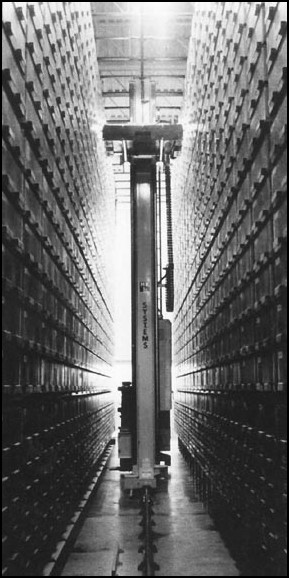
A case study of UNLV’s experience with ASRS, published last November in Library Hi Tech, a trade publication, describes ASRS as “a gigantic card catalog, except that the drawers are filled with bound volumes or boxes, rather than cards.” Robots traverse the installation knowing the location of each bin much like a regular address, aisle number, column number, and row number. A barcode is read whenever an item is placed in the bins, and a computer system records not only it’s location in the ASRS, but where within the bin it is placed. When an item is requested, the computer system retrieves the bin and show the operator where in the bin the item is.
Although the term “robotic” is used to describe the system, book removal is done by human hands. The “robotic crane is a mast with a platform to carry a bin that travels up and down an aisle on a track. When a request is received, the crane moves to the column where the indicated bin is stored.” The crane pulls the bin out on the platform, moves it to the end of the aisle, and brings it down for an employee to take out a book. Because the books are stored vertically in each bin, the top of each book is market with its size designation and the last two digits of its bar code to help ease identification.
UNLV’s circulation desk — where requests are made — is at the opposite side of the building, away from the ASRS, and requested items are “normally ready for pickup by the time the user walks to the services window.”
Although automated retrieval systems have been used in commercial warehouses for the past 20 years, the very first ASRS went online at California State University, Northridge. There, the Oviatt library installed in 1991 a system made by Eaton-Kenway, a company later acquired by HK Systems, Inc., the provider of Ekstrom’s.
Before UNLV could proceed, every item that was to be stored in ASRS needed to be measured. Periodicals were the first to go into automated storage, but officials did not have the time to fully measure what was in the collection. Based on average sizes and shelving estimated at 90% full, UNLV needed to store 20,000 feet of periodicals and 3,000 of government documents.
UNLV built a system housing 5,665 bins, the majority of which were 12 inch tall bins, divided into 10 compartments of 12 in. by 9.75 in. The “system consists of blue metal racks 37ft high holding galvanized sheet0metal bins painted beige. The racks are lined up in three aisles. On each side of each aisle there are 37 columns with 26 bins in each column.”
The computer system would keep track of the “minimum information needed;” barcode, title, author, and call number. The patron’s name would be recorded at check-out and deleted when the item came back.
While the computer system behind UNLV’s ASRS had the potential to become the entire catalog database, officials chose to keep the existing system, treating ASRS as just a way to retrieve books.
At Ekstrom, the planned expansion will feature office space for the McConnell Center for Political Leadership, a large new auditorium, and the aforementioned cafe.