 By Eric Butler
When talking to Tom Stevens, a thin, lively character with long hair and an apparent penchant for Coca-Cola, it’s difficult knowing when he’s talking about real people and when he’s talking about the game. Stevens is involved in what is called “live action role playing” — LARPing for short — which is a form of fantasy gaming that involves groups of people getting together to act out stories about vampires, wraiths, changelings and other supernatural beings. It’s not all done carte blanche; there are rules, published by gaming companies and used in LARP settings to establish environments, develop characters and resolve conflicts. Stevens’ group, of which he has been the president for all of its 10 years, is called GOPPLARPS. The name stands for Group of People Playing Live Action Role Playing Stuff. Stevens and the other members of the group realize it’s a silly name.
During our interview, Stevens referred to himself as “Louisville’s gaming guru.” The moniker may be a bit of a stretch, but he has played a significant role in Louisville’s gaming evolution. He began LARPing 12 years ago at a convention in town called RiverCon (its final event was in 2000). Stevens has run the gaming aspect for this as well as several other science fiction conventions in Louisville and around the region. When some individuals approached him about forming a stable LARP in Louisville — convention LARPs lasted only as long as the convention, usually beginning and ending in the same day — Stevens was eager to get under way. Thom Hershenrader was one of these first individuals seeking a Louisville-based LARP.
“A group of us had heard and read about LARPing, but nobody here had done it,” Hershenrader said. “We’d gotten some canon from the White Wolf fan club” — White Wolf is the name of the role-playing company that produced the game Vampire — “and were all interested in the idea, so we decided to start our own group. We got in touch with other people who were interested — Tom [Stevens] was one of these people — and it slowly grew over the years into what is now GOPPLARPS.”
Now, a decade later, the group is still going strong, and several other LARPs have formed alongside it. While they are all operating in the White Wolf universe, and though many players in any one LARP are involved in others as well, Stevens said the groups are independent of each other and storylines almost never intersect. “We are totally separate institutions and organizations,” he said. “Every game has its own flavor, its own focus, its own thing that you want.”
Stevens’ group plays a game called Vampire: the Masquerade. It is a gothic, horror-based game that involves a lot of politicking, where characters attempt to maintain or improve their status in the world setting. Stevens said the group currently has around 35 active participants. Of course, with that many players all interacting, and due to the seamy nature of the World of Darkness (the world in which their game is set) there are plenty of intricate story arcs for characters to deal with.
Trying to explain what happens in a live action game isn’t really a straight shot. It’s like trying to explain what happens, for example, in a city or in the world – in fact, it is its own world, literally a constructed environment, using real Louisville locations in which complex human drama is played out by the myriad characters involved. Plots and subplots and side plots are as numerous as the plots in your own life, fueled by years of history and social relationships, personal mistakes, grievances and aspirations. And this depiction of depth isn’t hyperbolic: Stevens said that GOPPLARPS has been running the same campaign, the same story, for eight and a half years.
“The best stories come from players writing a history for who their character is,” Stevens said. “The best and strongest players, and the players that have the most fun, are the ones who outline a task for their character to complete — even if it’s not completable. Saving the world, overthrowing local political figures, building a drug trade. Whatever they think makes an interesting story to try and develop.”
Hershenrader pointed out LARP’s emphasis on group play.
“It’s much more involved when you have more people,” he said. “When you get like, 50 or 60 — and we’ve had up to that number and more at GOPPLARPS — it’s more involved because you’ve got people doing things on political scales, people doing things in the underworld, people doing things to get themselves into certain positions of power, and sometimes people can be over here doing one thing and the mass of people never know it until it happens.”
“It’s just about creating stories and drama,” said Stevens. “Technically you cannot win. It’s really not good for really competitive people, because simply you cannot win, but technically you can lose, because you can be killed and your character gone.” When this happens, the player has to create a new character, and then returns to the game anew.
“That isn’t even necessarily a loss,” he continued, “because you may be playing your character: if the goal is to play a role, to define a personality and to follow through as a personality and that leads to your doom, then you’ve played well. I’ve had people do things that they knew absolutely would be the end of their character, and they do them because it makes the best story.”
This is a crucial point in understanding the reasoning behind role-playing games. Stevens and Hershenrader both made explicit comparisons of LARP to improvisational theater, in that it’s all about being in the moment and interacting with and reacting to the other characters to forge a story.
“It’s just for our entertainment at the moment,” Stevens said. “The stories just live in the minds of the people who have experienced it.”
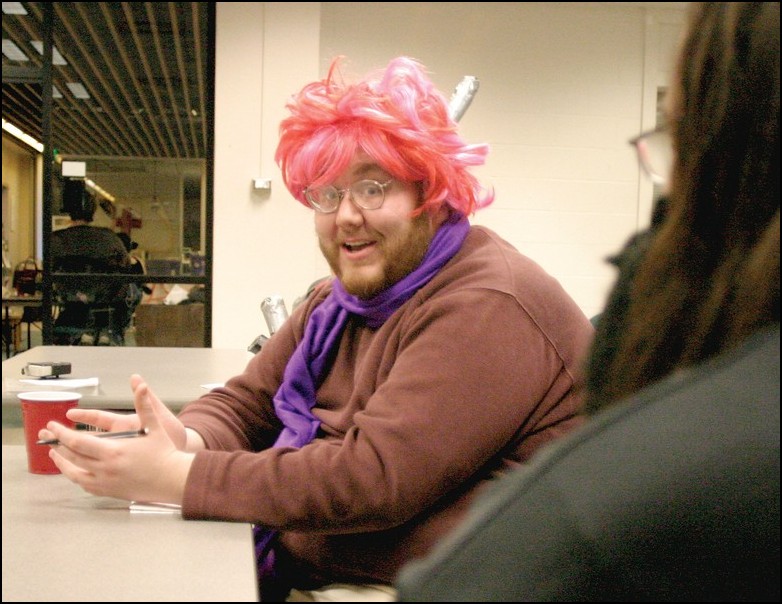
What’s most interesting about LARPing is that the whole game plays out through nothing more than several dozen individuals sitting around talking to each other over soft drinks. The whole dramatic progression happens in the verbal exchanges (and granted, the occasional theatrical gestures) of the players.
“Eighty percent of your game is summed up by sitting around talking,” Stevens said. “That’s what the game is.”
With that in mind, there is an inherent social element to LARPing that participants enjoy.
“That is a major focus for me, presenting an opportunity for people to meet and socialize,” Stevens said. “Everyone knows everyone and I feel like I made that happen. I’ve helped create a community. I am indirectly responsible for over eight weddings.”
Sean and Erin Mortensen can attest to this fact. They met each other at GOPPLARPS, first interacting in character and then sticking around after games to talk. “And then after one game she asked me out, and it took off from there,” Sean said. He proposed to her last February, exactly two years after that first date. It was during one of the games.
“We had met at that LARP, at that same location” — at the time GOPPLARPS was meeting at the Clifton Unitarian Church — “and it just seemed like an auspicious occasion.”
Aside from matchmaking, Hershenrader summed up the group’s motivations nicely.
“We’re just a bunch of people out here trying to have fun. We’re just trying to tell stories and give people something to do, because everybody gets sick and tired of the humdrum, everyday droll of life. You go to work, you try to pay your bills, and you have to deal with whatever bad things life throws at you. This is just a way to relieve stress and pretend to be someone else for a while — it’s just like Halloween. It’s like watching a movie or sitting down and reading a book. It’s a temporary escape from the everyday.”
Well put.