

 By Dennis O’Niel
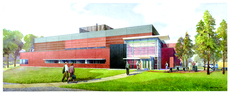
The University of Louisville held a ground breaking ceremony for its new multi-million dollar Center for Predictive Medicine at Shelby Campus on April 9.
The $34.6 million facility, which will house one of the 13 Level Three biosafety labs in the nation, will be used to research and develop vaccines for infectious diseases such as West Nile, SARS and bird flu. The majority of project’s costs is covered by a grant from the National Institute of Allergy and Infectious Diseases.
“We are hoping that our researchers will be able to determine why certain people fall prey to certain diseases and others don’t,” said U of L Executive Vice President for Research Manuel Martinez at the ceremony.
First year medical student Scott Bickel said, “I think it’s good to see U of L’s continued commitment to cutting edge medical research. These types of projects are great for elevating U of L as a research university.”
But prior to construction, some community members living near the site expressed fears that the facility would pose as an environmental hazard in community forums hosted by U of L.
U of L Executive Vice President for Health Affairs Larry Cook said, “We chose to appreciate the fact that people have legitimate concerns and tried to do everything we could to reassure members of the community.”
The other two biosafety labs in the state – located at the Health Sciences Campus and the University of Kentucky – have not reportedly encountered serious safety problems thus far. Both labs are federally certified for safety.
Construction on the 37,000 square foot facility is expected to begin by the end of April, and the center is expected to open in early 2009.
Cook said the new facility fits in well with the university’s plans to develop the Shelby Campus into a thriving research and technology center.
“This has been a grossly under-utilized campus,” Cook said. “President Ramsey is fully committed to maximizing our assets as much as we can. We are in the phase of exploring what we can do with Shelby right now, but we don’t want to treat this place as a forgotten campus.”
“It is frustrating because the campus is so far away, and isn’t well integrated as part of the university,” said Dion Mikkel a sophomore humanities major, “I think that we can do a lot more with it.”
U of L President Dr. James R. Ramsey said the new lab could bring economic development to the city and state. A recent study by the University of Texas, which has a biosafety lab, revealed improvements in the local economy due in large part to new jobs provided by their facility.
And U of L Media Relations Director Denise Fitzpatrick stressed the facility’s impact the university’s financial situation.
“Not only will it help [U of L] attract more federal funding, but it will also make us a national player in infectious disease research,” Fitzpatrick said. “[The facility] could also lead to patents and new business opportunities through which the university would receive additional money.”
“The more federal research funding U of L attracts, the more prestigious the university becomes,” Fitzpatrick said, “and that adds to the value of our degree for students.”





