 By Charlie Leffler
It’s hard to believe that an athletic program could develop a bad reputation in only four years of existence, but that is what the members of the University of Louisville rowing team have been faced with. The nearly tragic accident two years ago, when a barge ran over one of the boats, has become the calling sign for the program.
Since that time, a completely new coaching staff has been hired and safety regulations have been extensively revamped, but still the program cannot escape from the ominous shadow of its short past.
“We kind of inherited a program with not a very good reputation,” said graduate assistant Emily Egge. “I can’t tell you how many times I wear a rowing shirt in a coffee shop or something and somebody will come up and just try to make conversation, “Hit any barges lately?” It seems kind of funny until you realize there were some people that could have been very, very severely hurt and it’s not so funny anymore. That’s something that we’ve been very, very conscious of avoiding.”
Egge entered the program two years ago, along with head coach Richard Ruggieri and assistant coach Laurie Fetherstone. The three have concentrated their efforts on safety so that the attention will go back to the athletes themselves.
On Sunday, April 28, the Louisville public will get a chance to see something from the rowing team other than jokes about barge accidents. For the first time in school history, the U of L rowing team will be hosting a competition. The contest could be said to decide the best rowing team in Kentucky, but considering that Murray State is the only other collegiate team in the state, the label may be a bit overstated.
The team is now in the process of coming into its own. After coming in second in three of four races at Tennessee on March 30, the teams came back the following week to win three of four races at Cincinnati on April 6 and 7.
The mechanics involved in rowing are a lot more complicated than one might expect.
“People think that the rowing stroke is very much an upper body activity,” said Egge. “It actually is very close to being just a horizontal “clean” like the ones lifters do. You start off all crunched up with your legs. You start off pushing your legs, then engaging your back and your arms.” The rowers sit on seats that are mounted on a sledge and slide back and forth with each stroke. Shoes are also built into the decking where the rowers can get steady support and not have to worry about slipping. To make coordination even more vital, the blades of the oars are turned parallel to the water on the return stroke, then back to horizontal before reentering the water. Ironically, the speed does not come from the thrust of the oar through the water, but once it has been lifted out. The oars provide drag, so the boat only reaches maximum velocity when they are lifted. Therefore, coordination between the rowers and the coxswain is vital. The strokes must be timed perfectly so that the oars are only reentering the water when the boat’s speed begins to lag.
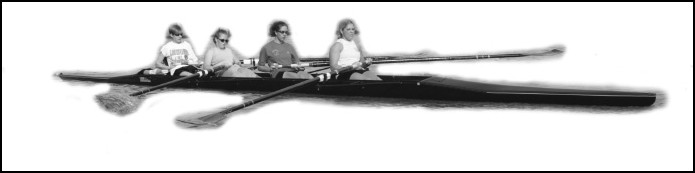
The Louisville teams compete at both the Novice and Varsity level in 4+ and 8+ divisions. A separate size of boat is used for each of the competitions, ranging up to the 8+ which is 56 feet in length. The boats are built for speed, but not agility. The boats can reach speeds of up to 15 mph, but are reminiscent of the Belle of Louisville when it comes to turning around. Each of the boats are smooth-bottomed with only a small stabilizer fin. “You have this little rudder here,” said Egge. “It’s about the size of a credit card to steer a boat 56 feet long and about one and a half feet wide. They’re not real responsive. So it takes a few strokes to get it steering. The coxswain has to always be aware. That’s their main priority. That’s why you have a coxswain.”
While the varsity teams receive scholarships, the novice team is composed entirely of walk-ons recruited from around campus. Egge said the turnover rate on the novice team is extremely high. Some of the athletes join the team not realizing the dedication and work that is involved. The 6:30 a.m. practices on the river, long weekends of travel, and the extensive time and effort that it takes to be a competitive rower are too much for some. That is why every fall, Louisville students will see the tables along the walkways of campus suddenly spring to life with the anticipation of recruiting new rowers. “The volleyball team probably hates us because we’re always trying to get them,” said Egge. “We see a tall athletic girl and we’re thinking she’ll make a good rower.”
As far as competing on the Ohio, it will be a ‘wait and see’ proposition. Anyone who has lived in this area for any length of time knows how unpredicable it can be. “Well, it’s not ideal,” said Egge. “I think we have a lot more to deal with than most people do because of the size of the river, the current, and the traffic that we get. But it’s really workable. A lot of other schools will have smaller rivers or lakes. A lot of whether if it’s a good course or not is going to depend on the current that day. So, we’ll see.”
Because rowing competition is so new to the university, the school is making the race into an event. Fans will be able to board the Spirit of Jeffersonville and ride out to the finish line of the race. Afterwards, there will be a cookout at the team’s boathouse off River Road.