

 By Stephen George
Another Senate Failure
Unrestrained emotions and booming voices of dissention stifled another Student Government Association Senate meeting last Tuesday, this time resulting in adjournment in mid-discussion.
Continued argument over what to do with the much-debated Adult Commuter Center Evening Student Services (ACCESS) center, as well as brief and heated discussion of the Multicultural Programming Fund, were the suffocating factors in an unruly and shapeless session, which again failed to meet parliamentary standards established for such meetings.
Presented at the start of the meeting was a report from President Chris Marlin, in accordance with Sen. Shannon Jeffries’ proposal at last month’s session, which detailed the history, status, and success of ACCESS and provided three options for a decisive future proposal.
The first, which until now has been assumed by many ACCESS supporters to be the SGA plan of action, is the closure of the center and assimilation of services into the Resources for Academic Achievement (REACH) program. According to Marlin’s report, SGA would “work closely with the directors of this program to establish a friendly atmosphere,” something most ACCESS supporters have labeled an essential component to the services.
SGA would also lower or drop altogether the $3 per semester per student fee that has primarily funded the center for the past two years, as well as “reallocate the funds within the SGA budget.” In the short term, according to the report, this would mean using the funds to create campus-wide student “lounge areas” to “provide the most used services in SGA/ACCESS,” which, according to surveys conducted by the ACCESS center and included in the report, are email/computer lab and copy machine usage, study areas, and coffee and cookies.
In the long term, funds may be redirected to a new Child Development Program at U of L, a possibility introduced by Marlin which is still in its fetal stage.
The second option for ACCESS outlined in the report is maintenance of the current form. Should this be enacted, it would “require SGA to establish a mechanism for increasing the Student Activity Fee. To maintain the operations, it would be recommended that the center have at least $20,000 to work with on top of the costs for salaries and benefits,” which currently account for roughly 91% of the current ACCESS budget.
Five points of maintenance are also listed within the potential proposal, which include “revis[ing] the vision of the center to be more inclusive of commuter students, renovation of the center, mandat[ing] that only work-study students could be employed outside of the permanent staff, [and] reduction to one permanent staff member, thereby easing the growth in the budget.” According to Marlin’s report, the projected cost of ACCESS by the 2009-2010 academic year would be $127,595. SGA also “should possess greater decision power in the activities of the center and staffing.” The report continues, “Since SGA provides the funding, it should possess majority decision-making authority.” The third potential proposal for the center would be to “create satellite centers across the campus for students,” something that ACCESS director Barbara King consented to the necessity for at the meeting, although not on condition of the closure of ACCESS. Under this potential proposal, SGA also recommended hiring a professional consulting agency to assist in assimilating these services throughout campus.
King and program assistant Donna Holmes, as well as student ACCESS supporters, which included several of the same senators and audience members advocating discussion of the Multicultural Programming Fund, spoke on behalf of the center, expressing its relevance and importance to providing a “unified campus community” at U of L, as one supporter put it.
The hostility of those involved was not masked or discouraged. “I will remember this,” said Holmes. “I will be voting.”
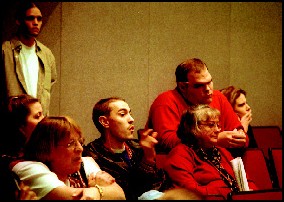
Tensions reached the watermark when, after Marlin’s attempts to quell the increasingly volatile audience failed, the discussion became a screaming match. Once again, insults were hurled at SGA from audience members and senators alike, and several audience members even brought signs with remarks directed toward the SGA central administration.
Another catalyst for the emotional and argumentative nature of the session was Marlin’s announcement near the beginning of the meeting that the Multicultural Programming Fund was again being removed from the agenda, this time at the urging of Student Affairs Vice President Denise Gifford. The fund was removed from the agenda at the October 5 session as well, then on the advice of acting President Ramsey.
“You’re playing with us,” arts and sciences Sen. Deonte Hollowell said to Marlin after the announcement. Marlin went on to inform the Senate that the $10,000 that SGA currently contributes to the African American Programming Fund, which has been frozen for the past several weeks, is now being overseen by acting Assistant Vice President for Student Affairs Al Herring.
Marlin also relayed three options SGA has come up with regarding control of SGA’s portion of the fund if the Multicultural Programming Fund proposal is passed. First, the Senate Finance Committee could oversee the funds. Second, a committee of three Senate Finance Committee members and three African American representatives could be formed. Finally, control of the money could be given to the Association of Black Students. To this option, Hollowell responded, “Nothing else is acceptable.”





