 By
By
It’s a cold March morning, an gasoline rich smell fills the air, with the engine revving up to 8,000 rotations per minute. Tires squeal as the car lunges from the start and off in to the course. As the car dodges cones left and right it nicks one and sends it flying, then makes a hairpin turn as the driver experiences two times his body weight pressing against him. The car darts out of the turn and into a straightaway, getting up to almost 50 miles per hour, then has to decelerate, making another hairpin turn…
The thrill of driving cars has been around since the birth of the automobile, and it still lives on today at University of Louisville with the Formula SAE team.
The Society of Automotive Engineers Mini Indy, as it was known at the time, was born in 1978. As a way for engineering students to put the things they learned in the classroom on the pavement.
The competition isn’t just about racing, judges also look at the design, cost report and presentation of the car. It now pits over 125 teams against each other, at each event. The competition has even gone international, having events in Germany, Italy, Australia and Brazil.
“Formula [SAE] teaches the real world applications of engineering, it also allows me to have a lot of fun and interact at school, while relieving stress from class,” said David Leezer, a sophomore mechanical engineering major.
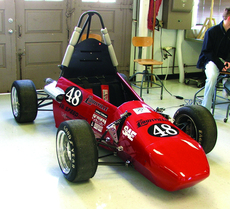
The car is built from scratch with students designing and building it from donations and contributions from companies.
O’Neal Steel donated almost all of the metal for the car, Atlas has donated machine time, while BAE Systems and the JB Speed School of Engineering donated monetarily.
“Without the sponsors there is no car. They are very important to the team,” said Kyle Brewer, sophomore engineering major.
While the sponsors make the car possible it is the students who build it. Over 1000 man hours have been spent on the car and at least another 300 are expected to complete it. They do it all; from welding to machining custom made and designed parts such as the oil pan, which is part of a new dry sump system for the car.
The car also includes some radical design elements. Since the car borrows heavily from European Formula One, there is a new suspension design based on production formula cars.
“I enjoy seeing how a thousand different parts go into making something complete,” said Mitch Peavler, a junior mechanical engineering major. “Its also great to work on a project and see it to completion.”
The team noted that most people don’t know how much work actually goes into the car, so they have fun answering a lot of the questions people have.
“My favorite question is ‘How fast will the car go?’ One time I answered ‘It will go faster then a moose,'” said Craig Ryan, a junior mechanical engineering major.
Since the team has never had the opportunity to “open the car up” they don’t know what the full speed is. However based on guesses from driving, the car has six gears, and they have only reached the fourth and so far they have gotten up to 65MPH, but the car isn’t all about top speed. Most of the races are meant to punish the car, with a lot of turns and shalom’s, pushing the car to its limits.
The team will travel to Fontana, Calif. to the California Speedway to race against schools from Japan, Europe and universities from across the U.S., but first they have to finish the car.
“The time required to finish these cars is astounding,” said Scott Menkhaus, a senior mechanical engineering major, “The time left to assemble the car as well as handling school is super hard. It really does take a team effort to do this, and luck has to be on your side.”