 By Julia Yetter
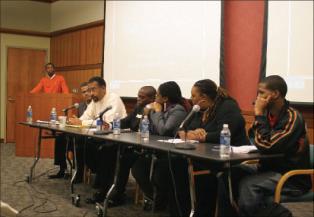
Last Tuesday evening, while students filled the Ekstrom library for this weeks’ final exams, downstairs in the Chao Auditorium a panel discussed the state of blacks at the University of Louisville.
The Association of Black Students sponsored the event, subtitled “Lifting the Veil,” quoting the African-American scholar W.E.B. Du Bois.
?Ali Scholar and President of ABS, Rosie Washington, organized the event, in which a panel of students and teachers reflected on the DuBoision theme.
“The Veil,” Washington explained, was a symbol of the “double consciousness” imposed on American blacks through “the sense of always looking at oneself through the eyes of others.”
According to Du Bois, Blacks in America lived their lives in two worlds, as Africans and as Americans. ?”Lifting the veil” Washington said, “is about reconciling this clash” between those two worlds.
The panel was moderated by Vice President of ABS Demetrius Gray, who set things off by asking Panelists how they would approach “lifting the veil” at U of L. ?Panelist and Porter Scholar President Errol Wint, was first to respond, and he set the tone for the first half of the discussion by emphasizing the importance of an education that emphasizes “black legacy” in this country. ?
Washington agreed with Wint, adding that the “African-American legacy is not appreciated by others.”
Fellow panelist Dr. William Tkweme joined the discussion by stating that one of the ultimate achievements of the 1960s Civil Rights Movement was “Black Studies programs,” which promote the black legacy.
By the end of the panel discussion, the conversation shifted towards diversity at U of L. ?This began with an inspection of the self-imposed segregation that takes place at U of L, with many students admitting that they tend to gravitate towards others like them and stay in their ‘comfort zones.’ ?
Washington stated that black students need to “mind the mentality of feeling smaller than other students or uncomfortable around other students,” and suggested that students “develop personal identification with issues.”
Panelist Jason Walker, who is President of the University chapter of the NAACP, noted that while many students talk about wanting to create a more diverse campus, few seldom do.
“The doors at the NAACP are open to everybody,” he said, “It’s just that only certain people walk through them.”
Walker added that the up-coming tuition increase, which he claims will hit black students harder than others, is not a reason for other students to disengage. ?
He stressed that the path to greater diversity is not about “compartmentalizing and isolating” issues, but about “students getting involved with issues that effect students.” ?
Wint urged students to “get involved because you care about the issues” and by doing so, other students will follow.