

 By Jennifer Hanley
Examining the African American Programming Fund
Anger expressed by U of L’s African American students as a result of Student Government Association President Chris Marlin’s proposal for the African American Programming Fund can be understood by reviewing the history of the fund itself.
The African American Programming Fund resulted from a list of demands that stemmed from racial tensions on campus. The August 25, 1999, incident in which University Police, Louisville Police, and the Secret Service arrested Porter Scholar Yinke Oyekunle was only the tip of the iceberg. After chasing two men onto campus, one man was apprehended at the other end of campus. The other man was seen running in the direction of the Student Activities Center. After observing the crowd in the Multipurpose Room, where the reception was being held, Secret Service agents identified Oyekunle as the suspect and arrested him. A report of the incident by the administration stated that the Secret Service soon determined that Oyekunle was not the individual they sought.
Porter Scholars and other African American students were outraged by the incident, which followed several other incidents on U of L’s campus that year and the preceding year. Dr. Pade Badru was carried away from his office in spring 1998 by University Police and was suspended. Several white professors had complaints filed against them for making racist statements in class. When a Pan-African Studies professor left in the wake of the suspension of Dr. Badru, the university allowed the Pan African Studies department to search for a replacement, but with the unusual stipulation that they do not formally advertise for potential applicants.
In September 1999, Dr. Ricky Jones and Dr. Ede Warner wrote up a proposal on behalf of the Black Radical Congress that outlined the injustices and demands for steps that the university should take to rectify those injustices. At the top of the list was a public apology from the administration and all the police agencies involved in the Porter Scholars incident. They wanted a black person in the administration with a voice. They wanted a commitment of finding black professors outside of the Pan-African Studies department, as well as a black dean in any school of the university. They also demanded that retention of African American students be addressed; 412 black students were lost between fall 1998 and spring 1999. The African American Programming Fund also came from this list of demands.
The idea behind the African American Programming Fund was to bring programming to African American students on campus, such as African American scholars and speakers. They come at a price, however, and the money that was available at the time was not enough. The Diversity Chair of SAB was only given $11,000 for the entire year. To bring in a speaker like Maulana Karenga cost $6100, which would decimate the programming for the year. The amount asked for in the Black Radical Congress’ list of demands was $45,000. The African American Programming Fund receives a total of $20,000; $10,000 of the money comes from the university and the other $10,000 comes from SGA.
Marlin proposed that the money would come under the control of the SGA’s Senate Finance committee. An umbrella Multicultural Programming Fund would be created with two parts: the African American Programming Fund and a Cultural Diversity Programming Fund. Forty thousand dollars would go to this fund, with $20,000 going to the African American Programming Fund. A maximum of $2,000 would be allowed for any one event, and that maximum would only be spent on a speaker, comedian, musician, festival, or any other event deemed appropriate by the Senate Finance committee. In addition to the money limit, RSOs that fall under the African American category cannot apply for money under the Cultural Diversity Programming Fund. Since the Senate Finance Committee is currently and has historically been composed predominantly of white students, the concern is that they will not understand what is important to cater to the needs of African American students on campus.
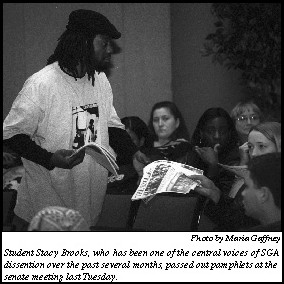
After months of tension, angry senate meetings, and outright disbelief, the fate of the African American Programming fund will be in the hands of an outside mediator. Currently, the SGA’s half of the money is under the control of Acting Vice President of Student Affairs Al Herring, and the university’s $10,000 is under the control of Vice Provost of Diversity and Equal Opportunity Dr. Mordean Taylor-Archer.





