 By Tyler Kerr
A student awakens in their dorm room and realizes they have overslept and have just minutes to make it across campus for a class. As they stumble about their room, they realize a mad dash across campus must ensue.
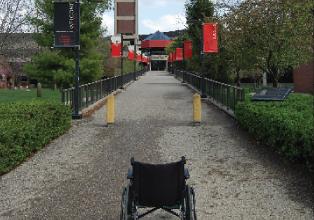
For any able-bodied student, this may be no problem. But what of the student worried about crossing the street with steep curb cuts that hamper their wheelchair, or waiting outside their class building for someone to help them with the doors?
While handicap accessibility is not a new issue, some disabled students have voiced their concerns about the day-to-day problems ?they encounter at the University of Louisville.
“I have to allocate more time to get everywhere because I’m not sure where all the entrance ramps will be located,” said Jaime Blanton, a graduate student and Ms. Wheelchair Kentucky.
Blanton said the handicapped access ramps are not always located in the most predictable place, such as the front door of a building.
Blanton also said there is the problem of human error and often inadvertent decisions that create barriers limiting access.
“There are a lot things around campus that students may not recognize as being a hazard to access for students with disabilities,” said Cathy Patus, director of the Disability Resource Center at U of L.
One example is that of bicycles wrongly locked to handrails alongside an access ramp, such as at the front of the Humanities Building, which can result in the handlebars impeding the path for handicapped students.
Patus identified other problem areas including large limbs lying on or near curb cuts, low hanging limbs, and the large puddles that have mired many sidewalks across campus.
“Some of these physical hazards are unavoidable and could pose some serious harm,” said Patus.
Patus added while the campus is working toward being more accessible, more open communication amongst all students and faculty remains a constant need.
“The hope is to create an environment of decreased barriers and more inclusion,” Patus said.
Harvey Johnson, U of L’s American’s with Disabilities Act compliance coordinator, said that he works to ensure that U of L is in compliance with the regulations of the ADA.
“I can’t say that everything on campus is where we should be, but we are meeting the requirements and will continue to make the university more accessible.”
Johnson added that he handles any student complaints regarding accessibility that are submitted to his office.
Blanton, however, said injuries have happened to disabled students due to problems with accessibility.
“I have to allow the possibility that I may turnover at a steep curb cut and suffer injuries, which has unfortunately happened to me and other disabled students I know,” said Blanton.
Jonathan Rourke, a recent graduate of U of L who is also blind, said he experienced difficulties when he was on campus.
“Navigating campus was always a daily undertaking because I never knew what I might encounter,” said Rourke. “A well-placed hole in a sidewalk is a real problem if I’m unable to recognize it exists.”
Rourke also said that a completely blocked off path, whether by a vehicle on campus or a deep puddle, could often cause him to turn back home and miss class due to not being able to find any emergency route.
Patus and Blanton both said there is a need on campus to increase student awareness about disabled students and their part in the university community.
“My goal is that everyone starts being active in the conversation and begin to recognize and think about what it really means to be accessible and inclusive,” Patus said.