

 By Erin Mccoy
A mass of devotees crowded into the reception room of the Speed Art Museum on Monday, April 18, but rather than gaping at the two imposing statues at the center of the room, all eyes were on two speakers erected before several rows of chairs. While museum employees carried in extra seats to accommodate the crowd, the voice of Azar Nafisi, author of the bestselling book “Reading Lolita in Tehran,” issued from the speakers, transmitted from the Speed Museum Auditorium a room away. The auditorium where Nafisi’s lecture took place had overflowed, and devout readers, instead of leaving, began to gather in the adjoining room.
“I knew that she was very well known,” said Dr. Nancy M. Theriot, chairperson of the Department of Women’s and Gender Studies, “and I thought that I could get an audience, but I had no idea how many people would show up. That was such a big success — it was amazing.”
Theriot, whose department organized the event for its annual Minx Auerbach Lecture in Women’s and Gender Studies, could be seen bustling around on Monday night, giving directions to delay the event as more people poured into the lobby.
When Nafisi finally approached the microphone there was a roar of applause, and then all grew silent. Most of the reception room crowd, unable to see Nafisi, fixed their eyes on the floor for the duration of her speech, intent upon her words.
“I wanted this meeting today to be a celebration of both the act of writing and the act of reading,” Nafisi said. And true to her word, she delivered a speech that wove her book and her own experiences into a discussion of the merits of the novel, and what value the genre has in a place like Iran.
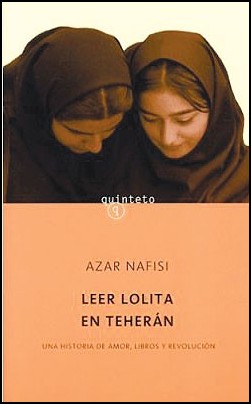
“Reading Lolita in Tehran,” published in 2003, is a nonfiction account of a book club that Nafisi organized in her home in Tehran, Iran. Nafisi invited seven of her most devoted students, all female, to visit her home once a week to discuss literature. The book is divided into four parts, each named after a particular work or author discussed — the first, of course, being “Lolita.”
“They read everything in English. Everything they wrote was in English. The class discussions would sort of move between Persian and English,” Nafisi said.
The book was an attempt to show readers how seven veiled women in Tehran could relate to a “frivolous” little girl in New England, or a Jane Austen woman of the Victorian era. In her lecture, Nafisi explained why a novel can make such unlikely, and universal, connections.
“From very early childhood I discovered that home can be taken away from you, but there is another home, that republic of the imagination, which no one can take away from you,” Nafisi said. The novel, she explained, “is always a celebration of what is extraordinary in what we call the ordinary. And that is the magic of the novel — that it shows you that just the act of living, that life, resisting the tyranny of time and death, in itself, is a miracle.”





