 By Andrew Krumme
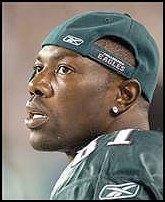
How big of an impact can an elite wide receiver have on a NFL team? Amidst the recent controversy surrounding Philadelphia Eagles wide receiver Terrell Owens, NFL enthusiasts have begun to question how the Eagles, and the team’s quarterback Donovan McNabb, will fare without Owens.
There is no doubt in my mind that the Eagles’ upper management had no choice but to suspend Owens for the remainder of the season since his never-ending antics may cause more harm than good, but listening to a late-night Fox Sports Radio talk show host several evenings ago sparked my interest in the whole situation. It made me think about not only Owens’ effect on the team when he is on the field but also how he contributes to the quarterback’s success, which ultimately translates to all-important wins and losses for an NFL team.
Before Owens’ arrival in the city of brotherly love, the Eagles were a great team. Much credit went to McNabb for leading the team to a handful of NFC Championships, but until Owens came, McNabb was in reality an above-average quarterback at best. What drove Eagles to three straight NFC Championship games and a Super Bowl appearance before Owens’ arrival was a great defense and steady offense, not McNabb.
Before Owens joined the Eagles, McNabb hadn’t thrown more than 25 touchdown passes. His best quarterback rating was a less-than-spectacular 86.0 in 2002, a season in which he only started in 10 games. Enter Owens last year and McNabb’s ratings skyrocketed to 104.7; his completion percentage jumped almost eight points, an absurd increase, especially for a veteran; and he finally reached the 30 touchdown throws plateau. He also threw only eight picks in 15 games started; the previous 64 games he started he threw 49. Clearly Owens’ presence on the field made McNabb an elite quarterback, not to mention that the Eagles finally made it to the big game that year.
So does this apply just to McNabb? Absolutely not.
Take a look at the year Minnesota Vikings quarterback Daunte Culpepper was having without wide receiver Randy Moss after Moss transferred to the Oakland Raiders. Culpepper was on pace to throw roughly 13 touchdowns to 26 picks. If he continued on with his horrendous season, he would have finished with a quarterback rating less than 75, which would have been the worst of his career.
And Randy Moss made no less of an impression on Oakland. Raiders quarterback Kerry Collins had long been seen as an average quarterback regardless of his team affiliation. He had never thrown for more than 21 touchdowns in his career and was always interception-prone. This year with Moss on the field, Collins is on pace to throw for 20 touchdowns and just six interceptions. In his 10 years as a quarterback, before Moss joined him on the field this year, he has averaged more than 15 picks and right around 15 touchdowns a year. And remember: this is a guy who led the New York Giants to a Super Bowl. The funny thing is that Moss hasn’t even been healthy for more than one game; his mere presence on the field is a great enough decoy for Collins’ quarterbacking skills to skyrocket.
So what does this mean for the Eagles? Perhaps they should have rethought their decision about suspending Owens. After all, it all comes down to winning football games, right?
The impact of an elite wide receiver like Owens or Moss is often overlooked. Right now, the Eagles are a team with no running game and a banged-up quarterback, a defense that is not what it once was and a ranking that leaves them in the basement of their division.
One has to wonder if they jumped the gun on casting Owens aside. Apparently the Eagles feel Owens’ off-the-field charades are more of an issue to the organization than his skills are an asset.