By Destiny Cater
The whistle cuts through practice at the University of Louisville L&N Credit Union, and a drill stops mid-rep.
New assistant coach Jena Otec steps in with a quick correction, not just where to move, but why.
High-level liberos don’t just react, she explains. They read the game before it unfolds, studying pass location, tempo and a hitter’s approach to anticipate the next touch.
Prior experience strengthens the court
For Otec, defense is trained anticipation.
That mindset followed her from her playing days at Purdue University to coaching stops at Western Kentucky University and now to the University of Louisville. The Cardinals finished 26-7 in 2025 and placed second in the Atlantic Coast Conference, backed by one of the league’s most consistent defensive units.
Libero Kamden Schrand led the team with 489 digs, averaging 3.91 per set. Chloe Chicoine added 340 digs, while middle blockers Cara Cresse and Hannah Sherman combined for 353 total blocks.
The structure is established. Otec’s role is refinement.
Otec credits her development at Purdue University under head coach Dave Shondell and former associate head coach John Shondell, where ball control and defensive precision were emphasized at an elite level.
A transition from outside hitter to libero deepened her understanding of offensive tendencies, giving her an instinct for reading attacks from both perspectives.
“When I transitioned into coaching, I knew I wanted to teach the game the same way: detailed, disciplined and defense-first,” Otec said.
Her coaching standard is direct; effort and defensive intensity are non-negotiable. The expectation is that the ball does not hit the floor without a fight.

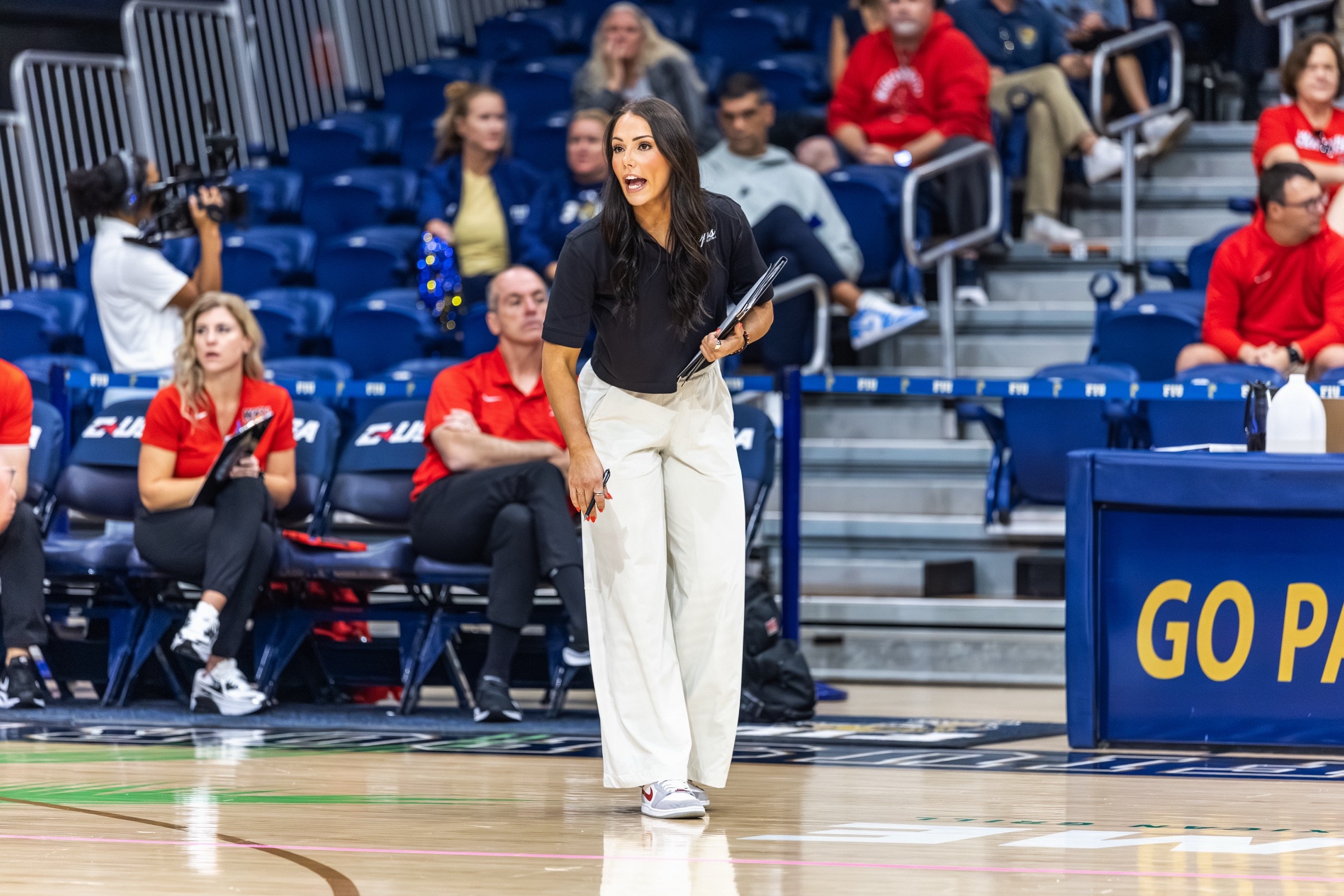
Jena Otec coaching from the sidelines. (Photo courtesy / Jena Otec)
Good coaching closes the gap
At WKU, Otec often slowed drills to isolate technique. At Louisville, practice tempo moves faster.
“We’re on a clock,” Otec said. “Coaching is about communicating quickly and efficiently so we maximize every minute in the gym.”
She is also learning her new roster in real time, studying personalities as much as platforms.
“I’m going to try to get a feel for who they are as players,” she said.
Head coach Dan Meske said Otec’s impact was immediately noticeable.
“Jena brought different terminology and unique ways we move through first contact,” Meske said. “Our players are already skilled. Trying different nuances is how you close the gap.”
Meske also pointed to Otec’s professional playing experience overseas as a differentiator, saying it allows her to connect with athletes who aspire to play beyond college.
Within her first week, Otec was tagging players in film review software, offering corrections and identifying patterns.
A winning philosophy
Defense, she explains, is a three-part system: serve, block and floor defense operating together. Louisville’s numbers reflect that balance. Alongside Schrand’s 489 digs, Cara Cresse averaged 1.46 blocks per set and Hannah Sherman averaged 1.44.
She emphasizes building relationships off the court, reminding players that their value extends beyond their role on the depth chart. That message resonates across a 16-player roster.
“We’re either all champions, or none of us are,” Otec said. “It takes all 16.”
Meske views that perspective as essential to sustaining Louisville’s competitive standard.
“The program is bigger than any one coach or player,” Meske said. “Our goal is that athletes leave better because of their experience here.”
Louisville’s defense already delivered results in 2025. With Otec’s emphasis on anticipation, precision and presence, the next step is sharpening a unit that finished near the top of the ACC into one that dictates tempo under pressure.
If that happens, the Cards will be cohesive, disciplined and unwilling to let the ball, or each other, hit the floor.
Photo courtesy / Jena Otec