By Lee Cole–
Walking into the Speed Art Museum for the first time, I felt like I had stumbled onto a great secret. Drawn in by the current special exhibit, “Renoir to Chagall: Paris and the Allure of Color,” I didn’t quite know what to expect. I thought that reviewing the exhibit would be rather straightforward, but it became clear to me, as each aspect of the exhibit continued to overwhelm and surprise, that a conventional review just wouldn’t do.
Spring has had an early arrival this year, and flowers and trees that normally wouldn’t be blooming until at least mid-April are now displaying their brightest colors. I can’t help but think that the motive behind the timing of this exhibit of mostly Impressionists and post-Impressionists is rather conspicuous. On campus, many go about their days seemingly unaware of the lovely show nature has put on for us. All of the beauty and color and vibrancy that we could hope for is right beneath our noses. I couldn’t help but think about this fact when I entered the Speed Museum. Like the blooming flowers, the Speed Museum is a secret gem on our campus, full of beauty and culture, and mostly unnoticed.
We live in a society where if you stop to smell the roses for too long, you’re liable to have a policeman come up to you and ask if you’re on any medications. The call to dispatch would go something like this: “Officer, there’s a strange man outside who has been staring at the same patch of tulips for all of 15 minutes. I think he might be crazy.” It’s unimaginable to many that one wouldn’t have something better to do. Art museums are one of the last places one can go to and really get away with staring unabashedly at beautiful objects for as long as one wants. This is why the Speed Museum, and this exhibit in particular, was such a joy.

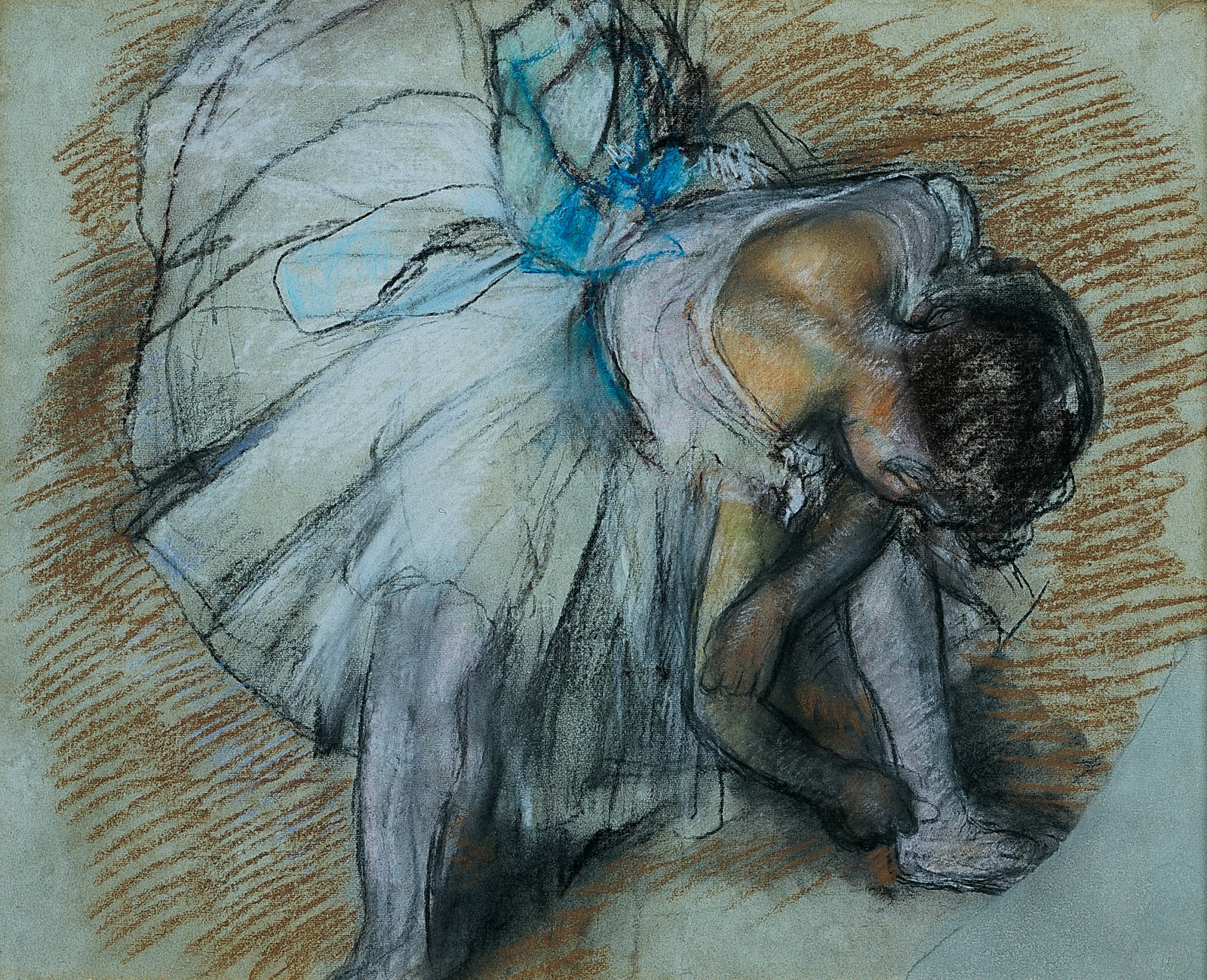
Edgar Degas' "Dancers at the Barre" exemplifies the Impressionistic style, done on the fly, capturing the transiemce of the moment.
“Paris and the Allure of Color” is really an apt subtitle for this exhibit, for as you approach the paintings in the lower level, you can feel their gravity and its pull. Museum goers enter with furrowed brows, some of them anxious and impatient, but when they stand before these paintings, you can see their jaws drop a little and their eyes widen. These Impressionistic works, with their swirling, vibrant color and breathtaking, dream –like forms, are intense and intoxicating.
The first painting to ensnare my attention was Berthe Morisot’s “Peasant Girl Among Tulips.” It was nice to see that spring was just as brilliant and gorgeous in 1890 for Morisot as it is now. The faint greens and purples of the peasant girl’s dress bled into the dense bed of tulips upon which she reclined. The borders of her figure and the background were blurred, and the result was one ethereal image of a young girl in nature, not separate, but as a part of the lush, spring foliage. The only thing delineating her from the background was the pale white of her face and the impasto pink of her lips.
Among the portraits, there were a few by Mary Cassatt, one of the only Americans in the exhibit, and a particularly interesting self-portrait by Fabien Launay. While most people, when Impressionism is mentioned, will think of Monet and Renoir – the big shots of late 19th century French art – the real crème de la crème of the whole exhibit was perhaps “The Joyous Festival” by lesser known artist Gaston La Touche.
Taking up almost an entire wall, La Touche’s huge canvass depicts an evening of revelry. Boaters listen to musicians playing a fiddle and fife, holding glowing paper lanterns. In the night sky, La Touche shows us fireworks with broad, loose brush strokes, impasto streaks and globs of white and brilliant teal. Pink smoke billows over the lapping, dark water, reflecting the exploding light of the fireworks, and though the faces are indistinct, it’s clear that they are laughing.
Revelry, or at least the after-effect of revelry, was also the subject of Jean Louis Forain’s “After the Ball, the Reveler.” Forain depicts a man passed out on a bed, still in his formal wear. The image is stark and plain, in sharp contrast to the vibrant colors of his other portraits. It is captivating because it is so honest, a rare glimpse into French life in the late 1800s that is both desolate and funny in a way.
Although the lesser known artists of the period had some of the more delightful works in the exhibit, there was no shortage of big names. There were several Degas sketches and charcoal pieces, a Monet landscape and even a Cezanne still life. Degas’ “Dancer Adjusting her Slipper” was so poignant and obviously done on the fly. You can see, in the urgency of the strokes and the shading, that he had come upon this image and tried to get it on paper as quickly as possible, before it faded from his memory. The result was a perfect moment of candid beauty captured for all to enjoy. It wasn’t complex and absurdly vibrant like La Touche’s wall-sized canvass. It was clear, simple and stark, and that’s all it needed it to be.
All I could think about as a I gazed into each framed picture was how glad I am that I’m not an art major, because if I was, I would’ve only been able to see the paintings in terms of line, form and perspective and all of the baggage of critical analysis and not as they really are. If I had been looking with those expectations, I might have missed the little things that made the works so endearing. I might have missed the opera goer in the background glancing down a plump woman’s décolletage. I might have missed the row of flickering gas lights along a street in Monmartre or the ballerina admiring herself in a hand mirror. If I’d been begrudgingly taking notes for an art history class, I might not have heard a mother tell her daughter as she pointed to a Cassatt, “Look, isn’t it amazing how she did that with her brush?” and the daughter telling her “I want to be a painter, like her.”
But what exactly made these works so fascinating? I think it was that they were so relatable; they reflected life in both its extraordinary and ordinary moments. Though it was 120 years ago in most cases, these images of French life were easy to understand, and the figures seemed familiar somehow. Each framed picture, each rendering, acted as a synecdoche, a piece to stand in for the whole, to make a window into life itself. Each person, when they come to that window, sees something of themselves and their own life in it.
It’s an understatement to say that this exhibit affected me, but too much philosophizing over it would defeat the purpose. Go see these works, and whatever else you do, try at least to savor them. I emerged from “Renoir to Chagall: Paris and the Allure of Color” into the bright, alluring colors of Old Louisville in spring. Needless to say, I noticed the flowers and took time to stare as long as I wanted.
lcole@louisvillecardinal.com
Photos courtesy thespeedmuseum.org