 By Justin Moore
The intense heat of forging metal, the finesse of sculpting a fine piece of piece of art, Glassblowing is an interesting and beautiful form of art.
The art of glassblowing, started in the middle of the first century b.c.e. that students at the University of Louisville, under the instruction of an expert gaffer, are able to take advantage of.
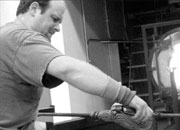
Glassblowing is the technique of shaping molten glass into an expression of the artist. As some sculptors work with clay, glass is a medium through which an artist can express themselves. The glass is heated in a hot furnace, when it is workable the glass appears a bright orange color. The artist can then mold it using the various tools and even expand the glass using a blowpipe, to make the glass expand like a balloon. What remains is a delicate, often beautiful piece of art.
The major spawned from the excitement over an event in 2003 called “A Celebration of Glass,” an event that brought glass art form all over to our beautiful city of Louisville.
“The celebration [of glass] had brought a lot attention to Louisville as a center for glass and people wanted to keep the energy and?enthusiasm?for glass going,” said James Grubola, Chair of U of L’s Department of Fine Arts and Director of the Hite Art Institute.
“The Celebration of Glass also?coincided?with the opening of Glassworks at 9th and Market Streets,” said Grubola. “They offered some workshops and adult-ed type of classes, but nothing formal.” U of L’s art department wanted to change that, “so we first started teaching hot glass in the fall semester of 2003 as a special topics course using the facilities at Glassworks,” said Grubola. Brook White was the first instructor.
But the winds of change were blowing, “We continued in that mode until January 2005 when we were able to hire Ché Rhodes as a full-time faculty member,” said Grubola.
According to Grubola at the same time Rhodes was hired, Fine Arts added glass as one of the areas within the 3-D studios in their Bachelors of Fine Arts program. “Shortly after [Rhode’s] arrival the Department of Fine Arts took over operational control of the Glassworks hotshop,” said Grubola, a hotshop is a place where glass is blown.
But the program soon outgrew the workspace.
So the program had to find a new place to work, “we wanted to retain the downtown location and the public access it gave us,” said Grubola.
Then, in February 2006, U of L and our fair city came to an agreement on a space that is now the Cressman Center for Visual Art at 1st and Main, and a year later, the space was formally dedicated.
“CCVA has 12,000 square feet containing a hot glass studio, plus other glass studios, sculpture studios and galleries,” said Grubola.
“There about 25 students working in glass every semester divided between?an introductory level class and an advanced level class plus l directed study classes,” said Grubola. “Students are generally working in the hotshop from 8:30 in the morning to past midnight every day except Sundays.”
Sundays are reserved for maintenance on equipment and allowing the furnaces to recharge.