By Staff Report
Demetrius Gray sat in the Multi-purpose room of the University of Louisville’s Student Activities Center last Thursday to observe the Student Government Associations annual election debate. Unfortunately, he was sorely lacking in company.
The debate, which featured 27 candidates running in the current election, had about eight to 10 non-candidate affiliated students in attendance, something that according to Gray, vice president of the Association of Black Students, was very disappointing.
“We are in a room that is capable of seating 300 people and there are only 50 people here, including those running for office,” Gray, a sophomore financing and accounting major said. “A lack of student involvement in the debate only enforces a level of secrecy in how student government operates.”
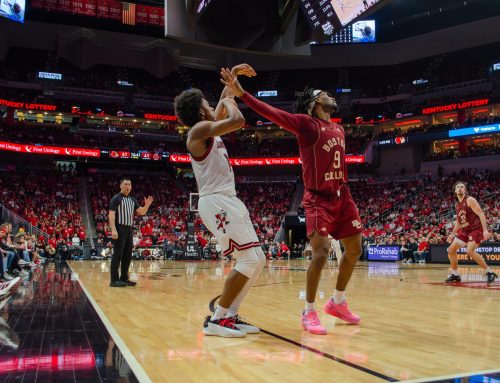
Attendance was not helped by the U of L men’s basketball game against the University of Notre Dame, which was taking place at the same time, with scores being announced throughout the debate.
“I really want to thank everyone for being here instead of the Notre Dame game,” Dani Smith, a candidate for SGA executive vice president, said. Smith is a junior political science and justice administration major.
SGA Associate Justice Chris Brown, a senior biology major, said there was a discussion about moving the debate to another time, but issues such as the availability of the Multi-purpose room and other time constraints were a significant factor in prohibiting this.
“Decisions are a part of life and sometimes you just have to make one,” Brown said. “In this case, students had to choose between the debate and the basketball game, among a host of other things they could probably be doing at 7 on a Thursday evening.”
Brown cited a lack of heavily contested races as a possible reason for lower attendance than in previous years.
“This year, for example, we have only one candidate running for SGA president,” Brown said. “The court realizes that some students had other commitments and that participation in the debate was completely voluntary.”
Despite the low debate attendance, many SGA candidates are anticipating a higher voter turnout this year, partially because the number of candidates running has increased from last year by 50 percent.
Rudy Spencer, the current services vice president and SGA presidential candidate, said “We have more students participating in this year’s SGA elections and they are doing a great job of informing students about the election. Also there has been a strong trend of voter turnout over the past few election cycles.”
According to Mary-Katherine Weber, executive president of the Resident Student association said there is a good chance that with more people getting involved with the U.S. presidential elections, there could be a much larger turnout for the SGA election on campus.
“Many of the candidates are very well known because of their involvement in a wide variety of activities on campus,” Weber, a junior communications major, said. “We have very popular candidates this year, so a huge number of students could choose to vote, just because they know someone running.”
This is no exception for Katrina Neubauer, a freshman undecided major. “I plan on voting for the Cards All In because I know a lot of them that are running and I think they will make the campus a better place,” Neubauer said.
However, Spencer, a junior communications and political science major, said he thinks otherwise.
“In my opinion,” Spencer said, “students vote on the issues.”
Last year a record of roughly 2,600 students voted in the SGA elections according to current SGA President Brian Hoffman, a senior political science major. Hoffman also said he thinks the top four positions; president, executive vice president, academic vice president, and services vice president, will have more votes than students running for senate.
Weber said she supports Hoffman’s claim that candidates for the top four positions attract more attention from students.
“The presidential and vice-presidential candidates are the ones with the most exposure during election time, so students know more about them,” Weber said. “Also, their positions are more prestigious as they have the most responsibilities.”
According to Hoffman any student at U of L can vote for the top four. ?However, students can only vote for council presidents, vice presidents, and senators from their own college. ?So someone running for education council president or senator can only get votes from students enrolled in that college.