 By
By
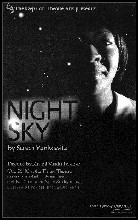
Speech has always been the steering force of the theater, but the Department of Theatre Arts’ upcoming production, “Night Sky,” will reach audience members not through its words but through what lies beyond them.
Susan Yankowitz’s “Night Sky,” directed at the University of Louisville by Russell Vandenbroucke, tells the story of the brilliant astronomer Anna.
Played by Pacey Walker, Anna is involved in a serious accident and loses her ability to retrieve language, a condition known as aphasia.
Anna’s intelligence remains intact, making her situation all the more heart-wrenching. Her intellectual world is locked within her own consciousness, her trapped thoughts pushing and shoving for an intelligible way out.
Anna eventually rediscovers language, but her journey is slow and psychologically brutal. She begins her rehabilitation by learning to form a few sounds, eventually progressing until she can form a few words.
“Teaching Anna to speak is like teaching a baby to speak but it is so much more painful with Anna because she has the intelligence level of an adult,” explained Stage Manager Carrie Faulhaber.
Anna’s condition is extremely intricate on a physiological as well as psychological level, and Walker went to great lengths to try to understand it.
She met with three speech therapists in the Louisville area and even sat in on one of the therapist’s session with an aphasiac patient.
“My biggest obstacle in playing this character is overcoming the burden of portraying the condition of aphasia accurately,” Walker said.
“Before reading the script, I had never even heard of aphasia, so I had a lot of work to do.”
Walker also faces the challenge of acting without speaking more than a handful of words.
For most theatric productions, body language and facial expressions serve as mere accessories to the spoken word, but in “Night Sky,” Walker has to project meaning almost entirely through silent communication.
Walker, however, seems surprisingly optimistic. “I have found new and interesting ways to communicate. The cast and I have done a great amount of research and we feel prepared to take the audience on a wonderful journey.”
Even with the scant dialogue, Yankowitz was able to inscribe an emotional intimacy into the script that only comes through personal connection to the subject.
That’s because the story was inspired by Joseph Chaikin, the leader of a theater group in which Yankowitz was a member. Chaikin was diagnosed with aphasia after suffering a massive stroke and Yankowitz wanted to chronicle her mentor’s story in an imaginative way.
In “Night Sky,” she does just that as she tells a painful, yet provocative, tale of a man she eagerly admired in the semblance of a woman who she came to invent.