

 By Thompson Perry
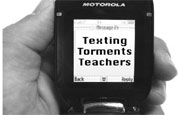
Since the inception of the profession, teachers have had to compete for the collective attention of their students. With the technology of the day strengthening its stranglehold on daily American life, this task may be becoming more difficult for educators at the University of Louisville and across the country.
With immense networking and communicating power at their fingertips, many students are tuning into their mobile devices during class–and tuning out their professors.
“I tell my students on day one since attendance in my class is voluntary, if you are in class I assume you are here to listen to what I have to say,” said biology professor Arnold Karpoff. “The agreement is that I will treat you as an adult as long as you do likewise to me.”
Not all students, however, are willing to return the respect given to them by university professors. Although most students would not be so bold as to actually take cell phone calls in class, the incessant sending and receiving of text messages during a lecture has “become an acceptable part of cell phone culture,” according to research from James Katz, professor of communication at Rutgers University and director of the Center for Mobile Communications Studies, and Jing Wang, a professor of Chinese language and culture at MIT.
Though only four percent of the students surveyed in the study considered it acceptable conduct to talk on a phone during class, 45 percent considered exchanging text messages permissible.
The distractions don’t end there, as an additional one-third of students saw no harm in playing games on a cell phone during class.
“For me, this is not a new problem,” said philosophy professor Osborne Wiggins. “I treat [text-messaging] just like students talking to one another during class. ?I bring it to an immediate end.”
Many students, however, argue that it is well within their rights to message others during class.
“I pay my tuition, show up to class and I’m an adult,” said Chris Prentice, a junior communications major. “So as long as I’m not disturbing the other people sitting around me, it really shouldn’t be considered a big deal.”
Though a few innocent messages may in fact be harmless, some students may be harnessing the messaging capabilities of cell phones for far more nefarious purposes, and this is presenting a whole new problem for instructors.
Many professors at colleges across the country see cell phone use as a dangerous path to a new, high-tech form of cheating. Messages can discreetly be exchanged containing answers to test questions and crib notes. In the crowded chaos of the college classroom, it can be easy for a student to use a cell phone as a cheating device.
“I’ve never seen it, but I don’t doubt that [cheating with cell phones] is a real possibility,” said senior philosophy major Warren Stephens. “With the help of technology, students today have a lot more opportunities to dishonestly get the grade.”
Though cell phones may provide a way for students to exchange messages or play games in class, the consensus among professors is that those who choose to partake in using cell phones during class are not only hurting themselves academically but also exhibiting poor manners.
“I can always look at [students’ text messaging] as just another episode of lack of respect,” said Karpoff, “and hope that their parents taught them better.”





