 By Hannah Gill
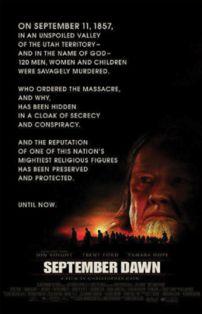
When movie makers try to cash in on historical tales, the injections that the stories receive from Hollywood usually pump them full of dramatized characters, love stories and clichéd dialogue, leaving behind little remnants of the actual story (Titanic, anyone?). Such is the case with the new “September Dawn,” the little-known story of the Mountain Meadows Massacre.
On Sept. 11, 1857, a wagon train of immigrants traveling from Arkansas to California were defenselessly murdered by a group of allied Indians and Mormons. Though the facts remain obscure as to who ordered the attack and why, in the end, 120 men, women and children were killed.
“September Dawn” highlights the supposed conspiracy within Mormon leadership which led to the attack, and explains why many considered this event the first known act of religious terrorism in the United States.
The film depicts the Mormons as nothing more than a bunch of mindless murderers, and the massacre as a completely unfounded act of malicious wickedness by them, failing to give other possible reasons, religious or historical, for the violence.
Besides lacking perspective, “September Dawn” muddles the story with a tale of two “Romeo and Juliet” lovers. Emily (Tamara Hope) a preacher’s daughter from the immigrant train, quickly falls for the Mormon Jonathan Samuelson (Trent Ford.)
Meanwhile, Jacob Samuelson (John Voigt,) Jonathan’s father as well as local mayor and bishop, meets with Brigham Young, governor and high-order Mormon leader. Both become heated over the recent death of Mormon prophet Joseph Smith, and rumors begin to fly about the immigrants and the threat they pose to the Mormons.
In the end, the Mormon leaders claim that through their direct connection with God, they were told to dispel the immigrants traveling to California.
The banal dialogue, as well as the over-dramatic and, therefore, unconvincing acting is something else to be considered. Relying too much on the historical aspect of the story, not enough effort was given to the actual script. The dialogue is nothing more than a slew of romantic drama hand-me-downs.
“September Dawn” gives a fairly accurate account of the actual massacre, and what the immigrants went through before they were killed.
However, the painfully unsubtle religious propaganda is enough to laugh at. Some tales just don’t wear Hollywood quite as well as others.