 By Chris Brown
Jesse isn’t your typical roommate. But then again, your typical roommate doesn’t stay at your side by day and sleep under your desk at night.
In fact, Jesse has four legs, a wagging tail and a keen awareness of his partner’s needs.
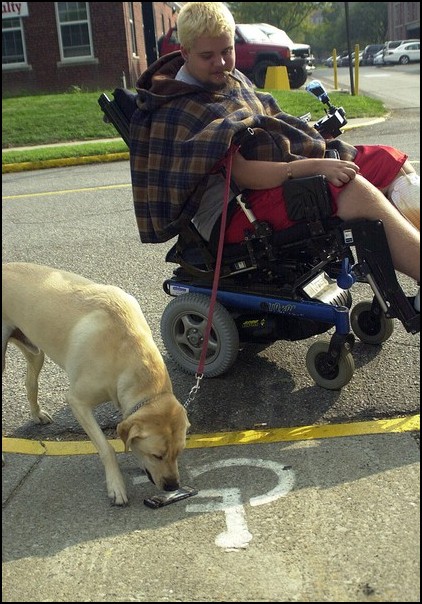
Jesse is a two-year-old, specially trained service dog who helps sophomore University of Louisville student Chris Lanham as he studies and lives on Belknap Campus.
“We’re together pretty much 24/7,” Lanham said as Jesse lay beside his motorized chair on the floor of his dorm room in Threlkeld Hall.
Lanham, a student from Fort Knox, Ky., who relies on his dog because of a mobility impairment, got Jesse through a U.S. Military-funded program called Animals in the Military Helping Individuals [AIM-HI] which trains service animals and their partners through a month-long preparatory course. The program has since closed. Lanham qualified because his father serves in the military. The cost of similar programs can exceed $20,000 for the animal and its training.
“He was already trained when I got him,” Lanham said, but the AIM-HI course helped the pair get used to working with one another.
Jesse knows 63 different commands and responds to the tone of Lanham’s voice. Lanham said Jesse helps him by opening doors using a special pull-rope or harness, picking up items Lanham needs and assisting Lanham around campus with other activities.
Lanham dropped his cellular telephone to the floor and called for his dog to retrieve it. Jesse quickly picked up the phone in his mouth and dropped it into Lanham’s lap, perching himself on the rail of Lanham’s chair as if awaiting reassurance.
“Good boy,” Lanham said with a loving ruffle of the lab’s sand-colored fur.
“He always gets attention,” Lanham said. “Everything he does is all positively reinforced. It might be a treat, or off-time, or attention, but he always gets rewarded when he does something.”
Even if Jesse strays from his duties, Lanham says it’s still important to use positive reinforcement to correct him. “Sometimes he gets too far from the chair,” Lanham said. “He likes chasing squirrels [and] he usually wants to play, so sometimes I have to bring him back in.”
However, “he won’t bark when he’s working,” he said. It’s when Lanham gives Jesse time off from his duties that he can let loose and be a puppy again. “When I’m at home and I can let him out in the backyard, he can run around and bark all he wants.”
Lanham said Jesse knows he has a job to do. It’s others around campus who from time to time have had trouble distinguishing Jesse from the typical canine pet. “Last semester, I was coaching intramural volleyball for the Threlkeld Hall team,” Lanham said. “When I went to the SAC Gym, the man working there told me, ‘There are no pets allowed in the gym.'” Lanham said he explained his situation, and even displayed an identification and license card from the AIM-HI program that pictures both Lanham and his dog.
Lanham said the worker at the gym told him, “I still can’t let you in.” Only after phoning other campus officials who were aware of Lanham’s service animal was he able to gain access to the gym for the intramural activity. He attributed difficulties with his service dog to “a lack of knowledge.”
People often fail to realize that Lanham’s dog, like other service animals, is not an ordinary pet. In fact, according to the United States’ Americans With Disabilities Act, Jesse falls into a class all his own. He is one of a special group of “guide dogs, signal dogs and other animals individually trained to provide assistance to an individual with a disability.”
“Federal law allows a service animal to go anywhere I can go,” Lanham explained. Department of Justice information says that service animals must be permitted to accompany their partners in any areas where patrons are normally allowed, and that a service animal or his partner cannot be segregated from other customers.
This policy extends not only to businesses and other establishments, but also to classrooms and other university buildings as well.
Due in part to that policy, and to ensure accessibility for students with disabilities, Kathy Pendleton, assistant director of U of L’s Disability Resource Center, said her office contacts professors whose classes will have students with service animals.
“Nine out of 10 times the professor will know ahead of time that there will be an animal in his or her classroom,” she said.
To date, she said her office has not received any complaints of service animals disrupting classes by barking or other behaviors. She said that only occasionally do service animals bark in university buildings, or bark at one another if they meet on campus. “The problem we have is people wanting to pet the dog,” she said.
Pendleton advises students and staff on campus to always ask permission of the human partner before addressing an animal. “Don’t pet the dog while it is walking,” she said. “And never feed it without permission.” Pendleton’s recommendations are consistent with those from a policy in place at The University of Wisconsin-Madison, a school with one of the nation’s most extensive policies regarding service animals on a university campus.
Pendleton said when problems do arise with an animal or partner-animal pair, her office resolves problems on an individual basis since U of L has no explicit policy regarding service animals. She explained, though, that the university hasn’t had a real need for a specific policy regarding the issue. The school follows federal ADA guidelines, as well as state and local regulations regarding service dogs.
When Lanham first came to U of L last fall, he said the housing office was “a little unsure” and worried that Jesse would bark in the dorm where Lanham now lives. But Lanham said the university was very flexible and worked with him to accommodate Jesse.
U of L Associate Director of Housing for Facilities Lionel Maten said the office had already started the process of upgrading the first floor of Threlkeld Hall for handicap accessibility before Lanham was a student.
“The first floor is now handicap accessible,” Maten said. “We widened the main door of the building and the door to the floor.” An electronic key card reader on the upgraded floor controls an automatic door that opens for Lanham so that Jesse does not have to open the door manually.
According to Maten, the university Housing Office is pleased with students’ reactions to having service animals living with their partners on campus. “We have never received a complaint,” he said. “Students have been very receptive of the animals. They have been very understanding.”
“He’s just like any other resident,” said senior James Taylor, the resident assistant on the floor where Jesse lives with Lanham. “He’s been here a year and a half and I’ve never heard him bark.”
Taylor said that Jesse meets other residents of the building in the dorm’s lobby, and that students who live in the building don’t seem to mind him at all.
Perhaps students’ good responses are because of the service animals themselves – both those used by students and those partnered with hearing-impaired faculty members in the American Sign Language Interpreter Training program.
“He picks up on emotions.” In fact, “he breaks down barriers,” Lanham said. “People can relate to him.” And that, said Lanham, helps people who might otherwise be intimidated by his disability approach him.
“He’s a good buddy,” Lanham said as Jesse sat loyally at his feet.