

 By Alex Bradshaw
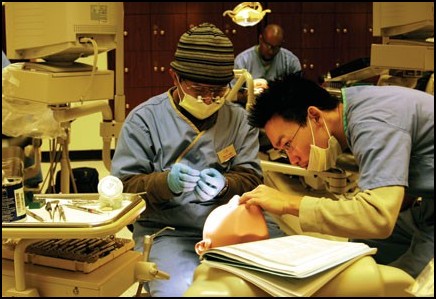
 PHOTO GALLERY: Minority Student Grant
U of L was selected to begin a new summer training program for underprivileged and minority students who are enrolled in pre-med or pre-dental programs.
Louisville’s dental and medical schools were chosen along with such prestigious organizations as Case Western, UCLA and Yale. U of L was one of 12 schools selected from a pool of 48 universities.
The goal of the program is to ensure that 70 to 80 rural, minority or underprivileged students are enrolled in dental or medical school.
“The program is trying to create a competitive applicant pool that includes more disadvantaged and racially or culturally diverse students,” said Ellen de Graffenreid, director of Communication and Marketing at the Health Science Center.
De Graffenreid said that minorities make up more than a quarter of the U.S. population but only about 6 percent of doctors and 5 percent of dentists are members of minorities. “Experts point to these statistics as a key factor in health care disparities,” de Graffenreid said.
The new summer training program is organized by the Summer Medical and Dental Education Program, and next summer will mark the beginning of the program for each of the 12 schools.
There is no limitation on age or years of study, and participation is free. By participating, students can earn three college credits in six weeks while training for a career in medicine or dentistry.
“The Robert Wood Johnson foundation provides $1.8 million for the program, and the University of Louisville is contributing more than $1 million in in-kind support,” de Graffenreid said. She explained that in-kind support includes administrative support, grant management, faculty services and staff time.
Many students get weeded out of the pre-med or pre-dental track because the numerous hard courses can discourage students who must study rigorously while their friends are out partying or relaxing.
Dr. Lee Mayer, a professor at the U of L School of Dentistry, does not want those students to change their course. “We need more dentists and physicians, and I am excited about this program because I feel like this is something excellent that can be utilized,” Mayer said.
“Also, there comes a certain time when students must choose a major. You can only take general requirements for so long,” Mayer said. “We want to encourage an interest in the sciences and lean students in that direction.”
Mary S. Joshua, associate director of Special Programs Minority and Rural Affairs at the Health Science Center, said the new summer training program will show how to apply all of that “hard stuff” to dentistry and medicine.
“This is a program where we show the students how they can apply all of the disciplines that they learn on the pre-med track,” Joshua said.
“There are so many hard classes that [pre-med and pre-dental] students have to take,” Joshua said. “We want to show the students how to apply calculus, biological science, and, dare I say it, organic chemistry.”
Joshua also said the new summer program is designed to show students the light at the end of the tunnel while helping them relate with different cultures.
“This isn’t simply an academic program. We feel like we are giving the students a realistic glimpse at what careers in medicine and dentistry are really like,” Joshua said. The program helps students ethically with what Joshua describes as “cultural competency,” as well as helping underprivileged students with financial strategies.
“Sometimes when I tell students what the tuition will cost for four years of medical or dental school, they change their undergraduate major,” Joshua said. “Some students can’t see past the financial barrier, which is understandable. But it is possible,” Joshua said.
De Graffenreid said the grant is a huge step for the university and the state.
“Ultimately, the program will benefit the state of Kentucky,” she said. “With a more racially and ethnically diverse work force, the needs of our increasingly diverse population can be met.”





