 By Melissa Moody
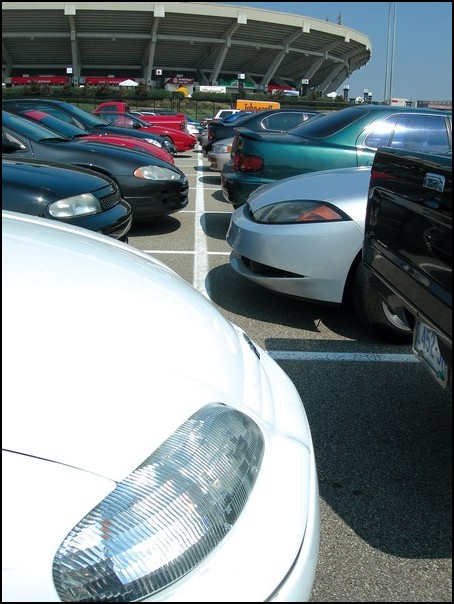
Michael Moore once said, “I didn’t go to college because I couldn’t find a place to park.” While Moore may have been joking, students across the country can relate to the relentless search for parking spaces, which can be especially scarce at urban universities. At the University of Louisville, students with permits weave in and out of parking lots and garages, while others circle Old Louisville looking for open on-street parking.
“The earlier you get on campus, the more likely you are to find a space. If you leave for lunch, though, good luck finding anywhere to park,” said U of L student Nhi Nguyen, whose friend’s car was vandalized after getting into a skirmish over a parking space.
U of L’s Belknap Campus currently has approximately 7,000 available parking spaces, but for the 2005-2006 school year, the university sold approximately 11,800 parking permits. The gap between available spaces and the number of permits hanging from rearview mirrors is considerably smaller on the Health Sciences Campus which has 2,714 spaces for 2,828 permits.
A difference of 4,800 at Belknap means that 41 percent of permits are sold without a tangible parking space accompanying them. For $745, students, faculty or staff can be ensured a parking space by purchasing a red permit. With the permit, they can park in a red reserved space or any blue, green or purple space. However, most people at U of L choose a cheaper option.
Chris Alexander, a doctoral student in Arts and Sciences, has a green permit and usually parks in the Floyd Street Garage. He said he has to leave home an hour early to make sure he gets a parking space.
“The most annoying thing about parking at U of L is that in the Floyd Street garage more than half of the spaces are yellow resident parking, and not only that, but the residents can park in the green spaces if there aren’t any yellow spaces available, which leaves about a quarter of the spaces in this ostensibly large garage available to students with green permits,” he said.
As of Aug. 22, the University Parking Office established a regulation stating that “the purchase of a parking permit does not guarantee a parking space.” According to Doreen Wood, assistant director of Parking at U of L, the regulation is common in the parking industry and shouldn’t alarm students.
“At an urban institution, with the majority of students residing off campus and enrollment in classes from 7 a.m. to 10 p.m., we feel pretty safe in providing the space needed,” Wood said.
The most widely purchased permit is the green one, which costs $91 for the entire year.
Some universities have attempted to eliminate student complaints about parking by offering students a better chance of getting a space at a higher cost. Others have tried using public transportation. The University of Wyoming implemented changes in its parking procedures following the example of successful Transportation Demand Management Programs at schools and in cities across the country. In states such as Colorado, Washington, Virginia and Wyoming, local officials, members of urban communities and universities are working together to solve increasing parking problems in the ever-growing concrete jungle.
Their programs discourage students from driving in single-occupant cars. Options include restricting the number of permits given to students who live near campus, increasing the number of buses and shuttles that go to the university, adding more scheduled bus stops and getting involved with the community surrounding the university to ease the shared parking difficulties.
However, some students are satisfied with the parking situation on Belknap Campus. Alexander and Nguyen said they typically find a parking space as long as they arrive early in the day. Others choose to simply forego purchasing a permit and take their chances on meters and residential streets surrounding the university. Regardless, more than 20,000 students attend class at U of L each day, and as construction expands and parking spaces grow more scarce, alternatives may become a more compelling option.