 By Matt Thacker
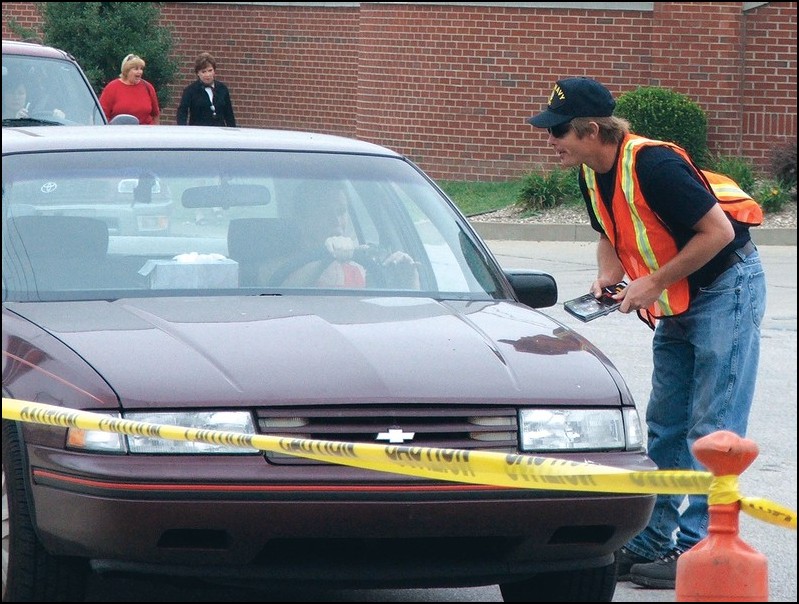
While fans filed into Papa John’s Cardinal Stadium on Saturday to watch the U of L football team take on Oregon State, volunteers stood outside passing out brochures to passing motorists and pedestrians. Their goal was to save lives.
Jefferson County has led the state for years in the number of collisions between trains and automobiles, said Wesley Ross, state coordinator for Kentucky Operation Lifesaver, Inc.
Ross and other volunteers from Operation Lifesaver, along with police officers from Norfolk Southern Railroad, handed out brochures to promote awareness of safety issues at highway-rail grade crossings.
“We want to inform the public about dangers associated with railroad crossings,” Ross said.
He said they chose the Floyd Street location next to Cardinal Stadium because of the heavy traffic before and after football games.
Ross said the location is particularly dangerous because motorists tend to stop on the middle of the railroad tracks and get stuck when the line of cars in front of them stops moving. Cars stopped on the middle of the railroad tracks have nowhere to go if a train approaches.
“We’re trying to educate motorists to stop on the safe side of the tracks,” Ross said.
In Jefferson County last year, there were 18 incidents at highway-rail grade crossings which resulted in five injuries.
One injury occurred as a pedestrian legally crossed the tracks on Lambourne Boulevard while the other four injuries resulted from 17 automobile collisions with trains.
There were also seven incidents involving trespassers. Three resulted in death and four in injuries.
Jefferson County accounted for nearly 25 percent of accidents at crossings and almost half of injuries and deaths resulting from trespassing last year in Kentucky.
Operation Lifesaver began in Idaho in 1972 and eventually spread to each continental state with a high rate of success. Kentucky’s program began in 1981.
In 1980, there were 198 crashes in Kentucky. The number decreased 10 percent the next year and steadily after that. Last year, there were 80 wrecks in Kentucky.
For many students driving or walking to school, railroads and trains are a part of daily life, from taking alternative routes to avoid being tardy to reading the sign near the water plant that warns people not to pass through railroad cars.
In fact, it’s common to see students trying to beat a train either by car or by foot, but Operation Lifesaver warns pedestrians and motorists to not take any chances.
They say that trains can be deceptively fast, and typically their sides extend three feet beyond the tracks.
Although university officials hope to improve the railroad situation on Belknap Campus, students can get used to the sound of trains passing by for now.
As one football fan said as he took a brochure, “I’ve never seen a school with so many railroad tracks in my life.”