

 By Mallory Bowman
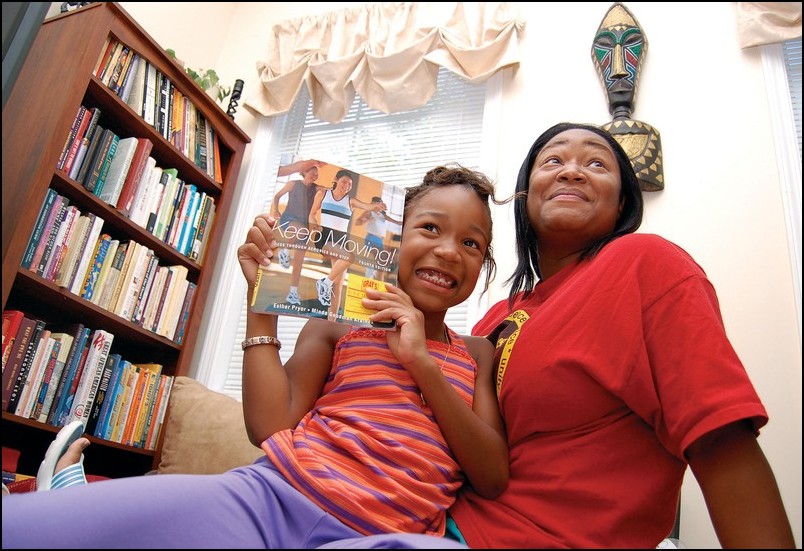
Trisha Metcalf is a full-time pre-dental student at the University of Louisville. She is a senior, and, like many other U of L students, commutes between school and her Louisville home each day.
Twenty-nine-year-old Metcalf, however, is different than many of the students she sits in class with. She doesn’t have free time to invest in campus clubs or extracurricular fun because she is also a single parent to her eight-year-old daughter Deja.
Metcalf said parenting is her number one responsibility, and that finding quality child care for Deja during her years at U of L has not been easy. She said she wishes U of L could give more assistance to students, faculty and staff who are parents, for example, in the form of on-campus child care.
“If U of L offered child care, it would benefit my quality of life, my study habits, and I wouldn’t go to school sleepy,” she said. “I’d be willing to pay for [my daughter] to be in a positive learning environment that would be close to me.”
Many student-parents share Metcalf’s sentiments. However, establishing an on-campus child care facility can’t happen overnight. U of L has operated two on-campus child care facilities over the last 33 years, the more recent lasting from 1981 until 1997. Both facilities closed because of lack of funding and quality-of-care issues.
Barb King, director of the U of L Access Center, is familiar with the problematic history of child care on Belknap campus. King served seven years as chair or co-chair of the Child Care Committee, a division under U of L’s Commission on the Status of Women. King said that throughout the years, the issue of child care has not been ignored; however, funding, location and feasibility issues have delayed bringing child care back to the university.
School administrators do recognize that U of L is somewhat behind on the issue compared to other universities, King said.
Michelle Clemons, chair of U of L’s Commission on the Status of Women, said she believes that in the past child care just wasn’t a top priority. “It’s a complicated issue,” she said. “But a metropolitan university in the biggest city in the state should not be without child care.”
Recently, however, strides have been made toward bringing child care to Belknap once again. Clemons said that a child care program is a top priority for the commission and the administration. She said one step in the process was taken in late June when the COSW met with Provost Shirley Willihnganz and received approval to bring an outside company to U of L to conduct a feasibility study for on-campus child care.
The study is expected to cost about $9,000, and would provide demographic information, a use projection and a suggested start-up plan, among other data.
Clemons said U of L’s Student Government Association, the office of the vice president for Student Affairs, the office of the provost and COSW have committed to funding the study.
A request for proposals to carry out the study was made to companies shortly after the provost’s approval, and the deadline for the proposals was tentatively set for mid-August. The request was recently closed with no award, Clemons said, but she could not comment on why.
However, Clemons added that she and current Child Care Committee Chair Susan Kosse are working on a revised request.
“COSW will be meeting with the purchasing department very soon to keep the project moving forward,” she said.
Clemons said the goal is to have the feasibility study completed by the end of this semester. She said that unanswered questions — such as cost for services, the type of child care facility to be created, the type of services offered and the location — are all subject to the results of the study.
“We’re not at the stage where departments or people are committing funding for the actual center,” she said. “We have talked briefly about the issue of location, but it’s too early yet. We don’t know yet how we are going to execute this because we must have the results of the feasibility study.”
However, Clemons acknowledges that if child care proves unaffordable, it won’t be offered. “Affordability is a huge issue for us,” she said.
Affordability is also where the SGA gets involved. Services vice president Sowmya Srinivasan said she became active in the issue immediately after she took office this summer. Srinivasan sits on the Child Care Committee, and has researched the history of child care on campus.
She said she believes it absolutely should be offered at the university, but agrees that if it is not affordable, it will not work. She also said that although the SGA does not want to front the funding for the creation and maintenance of the child care program, it does want to help defray the cost for students.
“We don’t want to be in the position of paying anyone’s salary or the start-up costs of anything, but when it does come to the students, we want to help make it affordable,” she said.
She said the SGA has committed to help subsidize the cost if a child care program is created. However, because no costs have been identified, Srinivasan doesn’t know how much the SGA would commit.
Most child care options for the university are likely to be expensive, and students, faculty and staff will have to weigh the benefits versus the cost of using such a service if a program is established.
If trends from other universities around the state hold true, child care at U of L could cost anywhere from $85 to $150 per week per child. Rates tend to vary, however, based on the age of the child and the length and number of days per week of the program.
If cost of child care falls within the estimated price range, a student working a minimum-wage job would have to work between 20 and 30 hours per week just to pay for full-time on-campus child care for one child if he or she received no financial assistance from the SGA or other sources.
But flexible rate plans, scholarships and discounts for multiple children or for students who meet other eligibility requirements have helped other universities create affordable child care options. “We have a flexible enrollment plan that many centers don’t,” said Rachel Sebastian, assistant to the director of the Northern Kentucky University Child Development Center.
Amber Boards, component coordinator for the child care center at Western Kentucky University, explained that her university’s program, like others around the state, draws on community participation to survive. Child care is available not just to students, but also to those outside of the university. This creates a client base stable enough to support the program.
At Eastern Kentucky University, the lab school’s child care program is open to the community and is backed by strong parent support, said Dana Bush, EKU lab school director. By offering services to those outside of the university, the school operates a child care center with 32 pupils and what Bush calls an “extensive waiting list.” Only two of the children enrolled in the lab school program, however, are children of university students; the rest are children from the surrounding community.
“We’ve had mothers in the hospital [after labor] call us to put children on the list,” Bush said. With such demand for the center’s services, university administrators and program coordinators don’t have to worry as much about lack of participation from student-parents.
Jennifer Bond, a senior and a single parent, said she is used to paying for her seven-year-old daughter’s day care, and would be willing to pay the same price to have her on campus. “I would have been willing to pay to have her close to me where I knew she was safe. I know that having child care on campus would have helped my academic career.”
For many students like Bond, it is the added convenience of being able to bring their children to school with them that makes an on-campus child care service worthwhile.
“It’s good for faculty and students because [their children] are so close,” Sebastian said. “They can stop by for lunch with their kids. It’s a good family resource.”
Student-parents whose children attend on-campus day care programs also don’t have to worry about driving across town and fighting traffic to drop off and pick up their children from outside day care centers or preschools. They can spend those extra minutes studying and catching up on assignments, which is valuable to parents with only a few minutes to steal between caring for their children and working to support them.
With so many uncertainties, it is hard to tell where the issue of on-campus child care will go next. However, Clemons said she and those who work alongside her have committed to making it a reality.
“I’m just going to keep pushing until someone tells me to back way off. Students, faculty and staff need this,” she said.
Bond said that although she won’t be around to reap the benefits of on-campus child care, she hopes the program will become a reality.
“I’ve had to work to pay for child care,” she said. “People should not have to forego their education because they have children.”
U of L looks to bring back child care
Providing quality child care on campus can be complicated.
As University of Louisville administrators develop plans for on-campus child care, several factors must be taken into account, including location, funding, affordability and perhaps one of the most complicated factors, the definition of child care itself.
U of L Provost Shirley Willihnganz said that the work to bring child care back to campus is in such an early stage, no one can say for sure how much it will cost, where it will be located or how it will be funded. However, she and others working with the issue understand that not all child care centers are alike.
“We say ‘child care’ as though that were a unitary concept, but really there are a number of different models to fit different needs with very different costs,” Willihnganz said.
Types of child care offered at universities around the nation range from drop-in day care centers to child development centers utilized by academic departments for research and observation.
Michelle Clemons, chair of U of L’s Commission on the Status of Women, said that currently no one is sure of what direction a child care center on campus would take. However, university officials have researched other college-based child care centers, and no program tends to be exactly like another.
According to a July 2005 Council on Postsecondary Education Campus Child Care Survey, the lab school at Eastern Kentucky University has two half-day programs for three-year-olds. Although 32 children are enrolled, only two students have their children enrolled there.
“Not many students use our program since it is half-day,” EKU Lab School Director Dana Bush said. “We serve students, faculty and the community. But it is very expensive. We wanted to do child care open to everyone, but we don’t have the funding to do so.”
EKU charges $1,600 for the school year for their morning program, which is four days a week, and $650 for their afternoon program, which is two days a week. It is funded through tuition, university support and grant money.
Unlike EKU, Northern Kentucky University’s early childhood development program serves a much larger number of children. NKU’s program serves children two to 12 years old during the academic year and six to 12 during summer. According to the child care survey, 77 percent of NKU’s 60 children enrolled are the children of students.
“We had an evening program, but the evening program wasn’t making enough money so it was done away with,” said Rachel Sebastian, the NKU child development center assistant director.
The cost for the program varies by age, beginning with the full-week program for two-year-olds at $140.
The University of Kentucky also offers an early childhood laboratory. According to the child care survey, it is licensed to serve 54 children and operates out of the College of Education’s department of Special Education and Rehabilitation Counseling. Currently 275 children are the waiting list, and the survey pinpointed that limited space is the factor stopping enrollment increase.
Clemons said that although the research of child care at other institutions around the state is imperative, and no specific definitions for the outstanding questions of what, how much, when and where can be answered before the results of the feasibility study are received.
“It’s just too early to tell,” she said.





